Manchester College Department of Education
based on the INTASC Principles
Curriculum-
C1-Plans informative, developmentally appropriate lessons and/or units
INTASC 2, 3, 4, 7
NBPTS 1,2
My Unit Plan on Ser versus Estar from Adolescent Exceptional Learners in Fall 2011 is an example of how I can plan an informative and developmentally appropriate unit. The coinciding rubric supports that this unit is both informative and developmentally appropriate.
My Interdisciplinary Unit Plan from Junior High/Middle School Methods in Fall 2011 is another example of how I plan an informative and developmentally appropriate unit. This unit involved different content areas and concentrated on the overall theme of being on a farm, or "Down on the Farm." This rubric shows that this unit was developmentally appropriate for middle school students.
C2-Teaches subject matter accurately to insure that students can meet P-12 academic standards INTASC 1, 3, 4, 7 NBPTS 1,2
The lesson plan included in my Impact on Student Learning Project from Adolescent Exceptional Learners in Fall 2011 is an example of how I ensure that my lessons follow, support, and reinforce P-12 academic standards for the state of Indiana in world languages. The coinciding rubric for this assignment validates that I have accomplished this requirement.
This lesson plan for an eighth grade ESL student that I created during both my TESOL Practicum and while in Junior High/Middle School Methods in Fall 2011 shows that I insure that students are being taught according to the proper academic standards. In the lesson plan, the standards are highlighted that coincide with the Academic Standards for TESOL/ESL students in eighth grade in Indiana.
C3-Uses interdisciplinary instruction as appropriate INTASC 1, 7 NBPTS 1,2
This rubric from my Interdisciplinary Unit Plan from Junior High/Middle School Methods in Fall 2011 shows that I use interdisciplinary instruction appropriately and that this unit was developmentally appropriate for middle school students. This unit involved different content areas and concentrated on the overall theme of being on a farm, or "Down on the Farm." Therefore, each lesson related to farming and contained concepts from other content areas. Lesson Plan Three was specifically designed to not only touch on a different content area, but to meet specific academic standards for a history class, as well as world language.
This lesson plan on the Cask of Amontillado shows how I can use ideas from both my Spanish class and an English class to involve students in a story that covers concepts from both content areas. This lesson plan rubric shows that I wrote a quality lesson plan. This lesson plan was intended for my ESL students to make a connection between their native language, Spanish, and their learning language, English. (Classroom Management: Fall 2011)
C4-Addresses subject matter from various points of view INTASC 1, 3, 4, 5, 7 NBPTS 1,2
This Reflection Paper is from a movie called Black and White that I watched in Structure of English in Fall 2009. It shows that I can look at the issues of gender and ethnic inequalities and biases, which are a problem in my subject area, and view these problems from a different point of view other than my own.
These student essays taken from a Spanish Three test that I gave during student teaching at Columbia City High School show that I can value how my lessons look through a student point of view. Students were asked to offer suggestions about what I could have added, changed, or rearranged to help them be more engaged in the soccer unit and to help them get more out of the unit overall.
C5-Teaches students to use critical thinking and problem solving strategies INTASC 4, 5, 7 NBPTS1,2
Lesson Plan Two, a part of my Interdisciplinary Unit Plan from Junior High/Middle School Methods in Fall 2011, shows how I teach students to use critical thinking strategies. Students are introduced to a blog from a young lady that spends a semester abroad in Costa Rica; students must compare their own culture to the culture explained in the text.
This Lesson Plan on Spain that I created in General Methods for Adolescent Learners in January 2012 reflects on my personal experience while studying abroad, helps stress to students the importance of learning a new language, and asks students to use critical thinking skills when discussing the practices of the target culture. This rubric shows that I met this objective.
C6-Uses effective questioning strategies INTASC 4, 5, 7 NBPTS 1,2
This Oral Presentation Lesson Rubric from Creative Dramatics in Spring 2010 verifies that I am capable of using effective questioning strategies with my students while giving a lesson.
This assignment on Bloom's Taxonomy required me to write one question for each level of Bloom's. Each question related to an article I read to improve my understanding of methods in teaching my content area. This assignment is from Adolescent Exceptional Learners in Fall 2011.
…assesses
students’ learning and development with a variety of measures
to aid in appropriate and effective
instructional planning
Assessment-
A1-Develops appropriate tools to assess learning
INTASC 4, 8
NBPTS 3
This Note-taking Worksheet with an Answer Key was created in Educational Psychology in Spring 2010. It shows a creative way to assess student learning through verifying that students have read the required material.
This Grading Rubric at the end of my Stage 2 Lesson Plan from Educational Psychology in Spring 2010 shows that I develop appropriate tools to assess learning. Students were asked to act out an event instead of reading and writing about it; through creative dramatics, students are doing the assessment by participating fully instead of taking a quiz or written assessment.
This pre-test and post-test attached to my Impact on Student Learning Project from Adolescent Exceptional Learners in Fall 2011 is an example of how I develop appropriate tools to assess learning. This specific assessment enforces a state standard and supports my learning goals for the included lesson, verified by this rubric.
A2-Assesses learning through standardized
and/or teacher constructed tests
to drive future instruction
INTASC 8
NBPTS 3
This Assessment Driven Instruction Paper from Educational Psychology in Spring 2010 shows that I can accurately interpret a student's standardized test scores and use them to shape my future lesson plans.
My Impact on Student Learning Project from Adolescent Exceptional Learners in Fall 2011 is an example of how I use state standards to shape my lessons, develop appropriate assessment tools to enforce a given standard, and how I will use the assessment data to drive future instruction. The coinciding rubric and included reflection for this assignment validate that I have accomplished this requirement. (This Impact on Student Learning took place over the course of one lesson.)
My second Impact on Student Learning Project from Teacher in Today's School in Spring 2012 is another example of how I use assessment data to drive future instruction. This Impact on Student Learning Project took place over the course of a full week-long unit over weather that I taught to my Spanish One students.
A3-Assesses learning through appropriate
alternative measures
to drive future
instruction INTASC 4, 8
NBPTS 3
This student example of a project that I assigned to my Spanish Three class during student teaching at Columbia City High School in Spring 2012 is an example of how I use other methods of assessment, besides just giving a test. Students were asked to use the current grammar point of reflexive verbs and bathroom vocabulary to create a short story. I used this assessment to measure how students were doing with the concept as a whole by using this rubric. This was my half-point assessment before taking the unit test over reflexive verbs.
As most standardized assessments are becoming computer-based, Columbia City High School is trying to prepare students for this switch from paper assessments by offering unit tests through a program called ExamView. The test I created in ExamView had two parts: Part One and Part Two. After giving the assessment, I wrote a summary that included students' scores from the test, describing the benefits and setbacks of using this program. (student teaching Spring 2012)
A4-Uses a variety of appropriate, authentic assessment tools and methods
INTASC 4, 8
NBPTS 3
The assessments used in my Interdisciplinary Unit Plan from Junior High/Middle School Methods in Fall 2011 show how I use a variety of appropriate and authentic assessment tools and methods. I vary my assessment techniques and use different types of assessment throughout this unit. Over the course of this unit, students are asked to do a reflective assignment, do short writing assignments, compare the target culture with the student's own, and complete both a short project and an end of the unit assessment. This rubric shows that this unit contained appropriate assessment tools and varied assessment methods.
…establishes
professional and reciprocal relationships with others invested in P-12 students’
learning
Relationships-
R1-Demonstrates sensitivity for diversity with students, colleagues, parents, college faculty, and/or community agencies INTASC 3, 4, 5, 6, 7, 8, 9, 10 NBPTS 5
My Diversity Workshop Reflection Paper, completed in Fall 2009, explains and outlines my sensitivity toward all people, groups, and backgrounds.
The comments in this evaluation from one of my cooperating teachers at Jefferson Middle School for General Methods for Adolescent Learners in January 2012 verifies that I have sensitivity for my students and am able to build relationships with students within a short period of time. (This is a two page evaluation. The first page is the evaluation and the second page is the comments.)
R2-Demonstrates with full awareness of ethical and legal responsibilities of teachers INTASC 7, 8, 9 NBPTS 4,5
My awareness of ethical responsibilities of teachers is demonstrated in my Classroom Management and Environment Paper, completed in Introduction to Teaching in January 2009.
My Cooperating Teacher Interview from Introduction to Teaching in January 2009 explains my understanding and knowledge of teachers' responsibilities.
During General Methods for Adolescent Learners in January 2012, I was evaluated by my professor with the guidelines and requirements outlined in a draft version of the RISE evaluation for Indiana teachers. This shows that I have experience in teaching to the expectations of today's teachers in Indiana and that I am successful in doing so.
R3-Values life-long learning, personal/professional development, and/or service orientation INTASC 9 NBPTS 4, 5
This Poverty Simulation Workshop Certificate, obtained in Fall 2009, shows that I value personal/professional development. In my reflection over this workshop, I explain what I learned from such a valuable professional development workshop.
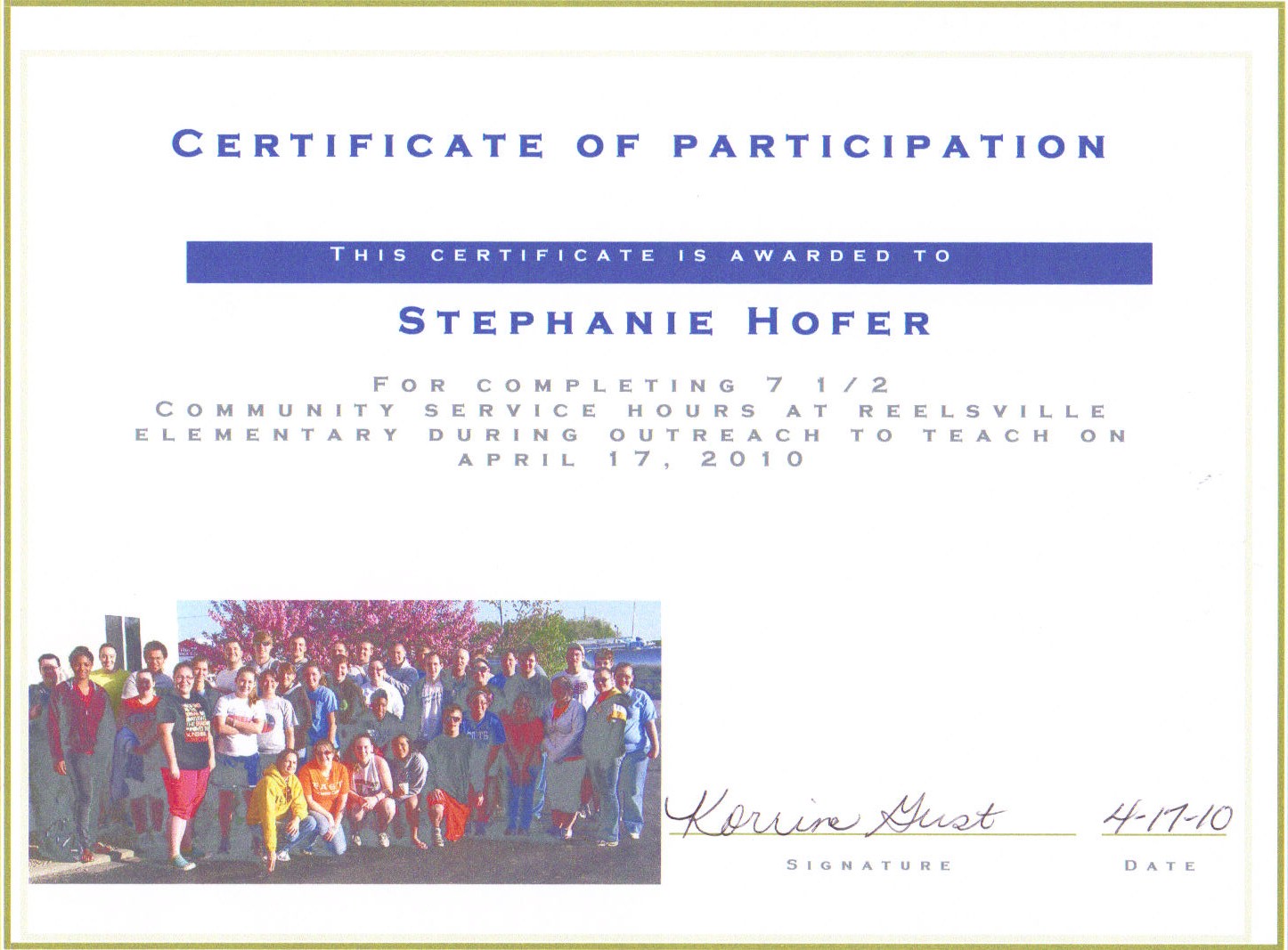
This Outreach to Teach Certificate from Spring 2010 shows that I value service orientation and development by volunteering at Reelsville Elementary School on April 17, 2010. In my reflection, I explain what responsibilities I had while volunteering and I discuss the impact my fellow teachers and I had on updating this school.
R4-Models appropriate oral communication skills
INTASC 6 NBPTS 1, 2
Upon completing Introduction to Teaching in January 2009, my cooperating teacher verified in my Evaluation that I model appropriate communication skills, among others.
This Group Oral Presentation Rubric from Introduction to Teaching in January 2009 shows that I model appropriate oral communication skills.
R5-Models appropriate written communication skills
INTASC 6 NBPTS 1, 2
R6-Motivates students to learn individually, collaboratively, and cooperatively INTASC 2, 3, 4, 5, 6 NBPTS 1,2, 3
This lesson plan included in my Exceptionality Poster Session Group Project from Adolescent Exceptional Learners in Fall 2011 is a great of example of how I will strive to have my students work individually and collaboratively. This lesson plan is a project-based lesson that asks students to first read about Don Quijote, and then complete a group project about what they have read. My rubric for this project shows that I completed all parts of the project fully.
This WebQuest del Quijote is a WebQuest built from the basic online WebQuest template that requires students to explore and do collaborative and individual projects about the famous novel from Spanish history: Don Quijote de la Mancha. Each individual and group project is clearly stated and explained as students advance in the WebQuest. This rubric shows that I have created a successful and beneficial way for students to work both individually and collaboratively.
R7-Plans lessons in collaborative teams
INTASC 6, 10
NBPTS 5
This Exceptionality Poster Session Group Project from Adolescent Exceptional Learners in Fall 2011 is a great of example of how I am able to successfully and appropriately work in collaborative groups with my fellow future teachers. For each of the three main elements to this project (a case study, group/project-based learning activity, and several characteristics and modifications for lesson planning), my group and I evenly divided the work and finished this project as a team. My rubric for this project shows that I worked well in a group and that our group was productive in finishing this project.
For student teaching at Columbia City High School, my first period class was a split class between Spanish Three, which I taught and Spanish Four, which my cooperating teacher taught. Her students were finishing up a unit on famous Spanish-speaking artists and painters; my students were reading about some of these painters in the culture section of our textbook. At the end of our units, the Spanish Four students presented their posters to my Spanish Three students. During the presentations, my students filled out this Presentation Outline to learn more about each artist.
…creates
positive and caring environments for student development and learning
Environment-
E1-Differentiates learning opportunities that respond to individual
learning styles and learning challenges
INTASC 2, 3, 4, 5
NBPTS 1, 2, 3
This Flyer and Workshop Certificate from the Autism Workshop on October 27, 2010 shows that I gained knowledge about Autism and how it affects students' learning. I am now more aware of Autism and how to respond to this learning challenge. In my reflection, I outline what I learned from this workshop.
This Flyer and Workshop Certificate from the Response to Instruction (RtI) and Positive Behavior Interventions and Supports (PBIS) workshop on November 11, 2011 shows that I gained knowledge about how to help students with learning disabilities, emotional disabilities, and mild to severe cognitive disabilities. I can now help students with these learning challenges succeed and motivate them to do their best. Because of this workshop, any student with one of the aforementioned disabilities in my classroom will be successful and have a learning environment catered to his or her needs. This valuable observation and statement is stated in my reflection paper.
E2-Uses a variety of teaching methods and materials INTASC 2, 3, 4 NBPTS 1, 2, 3
My Oaxaca Presentation PowerPoint and Coordinating Handout from my History of World Art course taken in Fall 2009 displays my ability to use Microsoft PowerPoint as an appropriate teaching material.
This rubric form my Unit Plan on Ser versus Estar from Adolescent Exceptional Learners in Fall 2011 shows that I properly and effectively use a variety of teaching methods and materials in both individual lessons and across the span of a unit.
E3-Uses a variety of appropriate media and technology INTASC 2, 3, 4 NBPTS 1, 2, 3
This rubric shows that my WebQuest del Quijote, built from the basic online WebQuest template, is an appropriate and beneficial use of technology in the classroom. Students were required to use both media and technology to complete an assignment within the WebQuest, versus a textbook.
This PowerPoint on Spain and coordinating worksheet that I created for my General Methods for Adolescent Learners class in January 2012 demonstrates my ability to incorporate technology into the classroom.
E4-Keeps records to monitor, document, and report student progress
INTASC 8, 10
NBPTS
1, 3
E5-Manages student behavior in positive, safe ways INTASC 2, 5 NBPTS 1,3
My Classroom Management Plan from my Classroom Management course in Fall 2011 fully explains and shows how I will manage student behavior in positive, safe ways. This rubric supports that I have truly thought about how I will manage student behavior.
While teaching a lesson in General Methods for Adolescent Learners in January 2012, my professor did a Walk-Through assessment which critiqued my teaching style at a spontaneous and unexpected time. This evaluation shows that I was managing student behavior in positive, safe ways.
During student teaching at Columbia City High School in Spring 2012, I learned how to manage student behavior in positive, safe ways. When my management techniques did not solve the problem, I sometimes had to contact parents in order to help the student regain focus in my classroom. This First Parent Contact Record and Second Parent Contact Record show that I do care about the success of my students academically and socially. (These discipline records are about two different students.)
E6-Models conflict resolution skills
INTASC 2, 5, 8
NBPTS
1, 3
E7-Engages in research and reflection
on best practices in teaching
strategies INTASC 1, 2, 7, 9
NBPTS 4, 5
My Field Experience Reflection Paper from Educational Psychology in Spring 2010 discusses what I believe to be some of the best teaching strategies as a sophomore teaching candidate.
My Final Reflection Paper from General Methods for Adolescent Learners in January 2012 explains how I have changed as an educator and discusses what I learned from my experience at Jefferson Middle School that helped prepare me for student teaching as a senior teacher candidate. This rubric verifies that I used research to determine what I believe to be the best teaching strategies.