Curriculum Assessment Relationship Environment
Curriculum…constructs and delivers appropriate curriculum for P-12 students.
C1 Plans informative, developmentally appropriate lessons and/or units.
INTASC 2, 3, 4, 7
NBPTS 1, 2
Within 1st grade science, students should be exposed to the process skills of observing and classifying, in which this lesson plan concerning magnetism does an excellent job of exemplifying these skills.
Based upon fourth grade standards, specifically Social Studies and English/Language Arts, I created a literature focus unit that is centered upon the book Sarah, Plain and Tall. This unit of study also displays my ability to incorporate the five stages of reading: pre-reading, reading, responding, exploring, and applying.
C2 Teaches subject matter accurately to insure that students can meet P-12 academic standards.
INTASC 1, 3, 4, 7
NBPTS 1, 2
After reading King Leopold's Ghost by Adam Hochschild for my African History class, I wrote an essay that centered upon the topic of slavery; therefore, this paper displays my ability to teach on its subject matter.
During my Essential Skills in Music course, I taught a math and music lesson, in which my professor assessed my teaching abilities. Overall, I think the score reflects a positive outlook, saying that I was able to teach the subject matter accurately and according to Indiana's state standards.
C3 Uses interdisciplinary instruction as appropriate.
INTASC 1, 7
NBPTS 1, 2
This sixth grade social studies lesson plan, concerning modern culture and society, engages students in the learning of modern cultures from all over the world. Within this lesson plan, the teacher is to demonstrate the comprehension strategy of summarizing, in which students will follow suit by making use of it in order to complete their graphic organizers.
Students within first grade should be learning about the economic concepts of goods, services, producers, consumers, and scarcity. All of these concepts are displayed within my first grade social studies economic unit, which incorporates twelve different subject areas.
C4 Addresses subject matter from various points of view.
INTASC 1, 3, 4, 5, 7 NBPTS 1, 2
This New Year Celebrations lesson plan is intended to enhance students' outlook on how another culture, the Chinese, observes the New Year's. More specifically, students will be reading This Next New Year and comparing and contrasting the ways the Chinese celebrate the arrival of a new year to that of "Americans."
It is important for students to understand that everyone has different feelings about the same kinds of things; therefore, I created this lesson that centers upon the subject of "I-Messages."
C5 Teaches students to use critical thinking and problem solving strategies.
INTASC 4, 5, 7 NBPTS1, 2
When teaching upon the subject of the first Thanksgiving, it is important to present more than one side of the story. This lesson, entitled "The Different Outlooks on Thanksgiving," incorporates the views of the Indians and the Pilgrims, in which the students are required to place themselves back in that time period, as though they are an Indian or Pilgrim.
Upon the topic of "magnetism," I have constructed a guided discovery lesson plan that engages students in learning upon the subject, as well as have a chance to explore with various teacher-approved items. Near the end of the lesson, students will have the opportunity to explain, to the class, what they discovered through their investigations.
C6 Uses effective questioning strategies.
INTASC 4, 5, 7
NBPTS
1, 2
These questions, concerning the trade book Corduroy, demonstrate my ability to effectively formulate questions based upon the six different levels of Bloom's Taxonomy.
Taken from my economic unit of study, this storytelling lesson is centered upon the topic of services. When beginning this lesson, I ask a series of review questions from the previous day's lesson, as well as a variety of Bloom's questions during and after reading, so that I may gain an insight into how well the class is understanding the material.
Assessment…assesses students’ learning and
development with a variety of measures
to aid in appropriate
and effective instructional planning.
A1 Develops appropriate tools to assess learning.
INTASC 4, 8 NBPTS 3
This written test, concerning fundamental movements, shows that I am able to construct an assessment that will appropriately measure my students' ability to comprehend information.
Concerning my first grade economics unit, I created two assessments that would measure the students' knowledge before the unit of study commenced, as well as their understanding after the unit had been completed. The pretest and posttest are both five questions in length, but the posttest is slightly more difficult in that it asks for written responses unlike the pretest, which has the students circling the correct answer.
A2
Assesses
learning through standardized
and/or
teacher constructed tests
to drive future instruction.
INTASC 8
NBPTS 3
Along with a classmate, I helped create a minilesson on echo reading. After teaching this minilesson to our class, we both reflected upon it individually, keeping in mind the students' responses on the assessment pieces, as well as the teacher's comments.
After teaching three lessons upon customary units (inches, feet, yards, and miles), I presented my math class with a quiz that I created on my own. Attached is a student's quiz, in which you can see how she responded to each of the questions.
A3
Assesses learning through appropriate
alternative measures
to drive future instruction.
INTASC 4, 8
NBPTS
3
Within this first grade science lesson plan, on humans and trash, the teacher has students completing two different assessments. The first one involves the students drawing what might happen to an animal given a piece of trash; however, the second assessment entails students placing various trash items in the correctly labeled bins (aluminum, cardboard, plastic, paper, glass, and actual trash).
During the fall of 2009, I completed an in depth case study, one that focused upon a 4th grade student's reading abilities. To see the progress that was made, you can read through the document, in which you will see the three assessments I administered (two of them were Core Vocabulary Screening tools and the other was an IRI).
A4
Uses a
variety of appropriate, authentic assessment tools and methods.
Relationships…establishes professional and
reciprocal relationships with others invested in P-12 students’ learning
INTASC 3, 4, 5, 6, 7, 8, 9, 10
NBPTS
5
Each and every classroom is bound to encompass a multitude of diverse students, whether it be in their outward appearance or their feelings within. No matter the students' differences, the teacher should demonstrate sensitivity toward their beliefs, in which this important view can be found in my "Celebrate Diversity" paper.
R2 Demonstrates with full awareness of ethical and legal responsibilities of teachers.
INTASC 7, 8, 9 NBPTS 4, 5
INTASC 9
NBPTS
4, 5
R4
Models
appropriate oral communication skills.
INTASC 6
NBPTS
1, 2
During the fall of 2009, I had the opportunity to observe and participate in a multicultural school setting. As you can tell from this field evaluation, which divided into two separate links (page 1 and page 2), I was able to efficiently work in a variety of settings, in which I taught for brief periods of ten minutes all the way up forty five minutes in a given lesson.
R5
Models
appropriate written communication skills.
INTASC 6
NBPTS
1, 2
Whether parents and/or legal guardians realize it, they could be implementing a family literacy routine within their home. Unfortunately many parents are not informed as to the importance of family literacy; however, if they were well-informed, then they might implement some form of reading and writing within their home environment. In order to gain a better understanding as to why I value to this topic, you should read the research paper I wrote with Education 340: Literacy Block.
R6 Motivates students to learn individually, collaboratively, and cooperatively.
INTASC 2, 3, 4, 5, 6
NBPTS
1, 2, 3
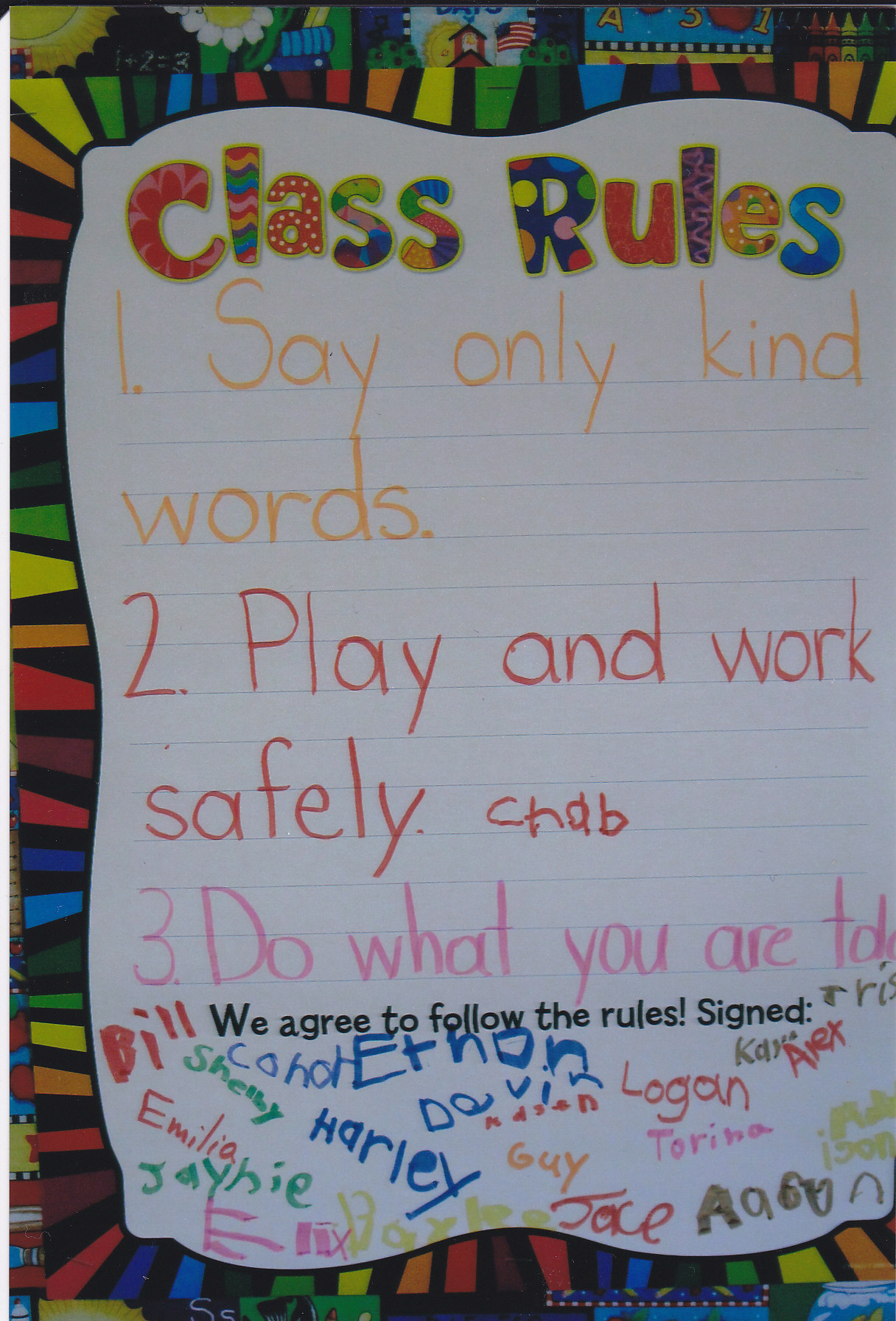
The first few days of the school year are the most crucial, in that relationships are formed and rules and procedures are dispensed. It is important for the teacher, as well as each child, to become acquainted with everyone in the classroom. At the beginning of the school year, I did not know any of the students in my fourth grade student teaching placement; therefore, I thought that carrying out a naming activity would be beneficial, in which the students were to write down four facts about themselves and then share these facts with a partner, who would, in turn, share part of this information with the whole class.
R7
Plans
lessons in collaborative teams.
Environment
E1
Differentiates learning opportunities that
respond to individual
learning styles and
learning strategies.
INTASC 2, 3, 4, 5
NBPTS
1, 2, 3
This science lesson plan, concerning rock types, is an excellent example of how I could engage a multitude of students with varying learning styles. For instance, I would have students examining the rocks by feeling their surface (bodily-kinesthetic) and looking for discrepancies among the different rocks (visual-spatial and logical-mathematical), as well as listening to teacher and student explanations (verbal-linguistic).
For three weeks in January, I participated in a reading research program that was stationed at Manchester Elementary School. Within this project, I created and taught reading lessons that tailored to the needs of visual learners. Throughout our time together we used a variety of materials; however, one thing always stayed constant and that was that the lesson activities centered upon the visual learning style. This letter, written by the principal investigator of the project, proves that I affirms that I carried out the aforementioned statements.
E2 Uses a variety of teaching methods and materials.
INTASC 2, 3, 4 NBPTS 1, 2, 3
Over the course of a semester, I read 30 trade books and from these books, I created several different activity ideas. These varying ideas are compiled together in a Trade Book Binder, which demonstrates my ability to use a multitude of teaching techniques, as well as materials.
The fourth lesson within my economics unit, "Money Matters," deals with the subject of mathematics, in which students learn the values of coins, practice counting them, and then they have an opportunity to exchange their coins in a store mock-up. So within this lesson, students are being exposed to pennies, nickels, and dimes, as well as the concept of paying money to buy actual goods.
E3 Uses a variety of appropriate media and technology.
INTASC 2, 3, 4 NBPTS 1,
2, 3
My potential to create appropriate lesson projects that utilize the Internet is demonstrated within my "Literacy Project." To be more exact, this literacy project focuses on one trade book: Spring Thaws, in which students can complete a series of six reading activities. Also included is the rubric that was used to evaluate my performance.
Incorporating the use of disposable cameras, this "Experimenting with Peanut Plants" lesson plan showcases my ability to integrate appropriate and proper technology within a given lesson. More specifically, students were to document, via scientific journals and disposable cameras, the growth of various peanut plants within different kinds of foundations, such as sand, potting soil, and clay.
E4
Keeps
records to monitor, document, and report student progress.
INTASC 8, 10
NBPTS
1, 3
This case study, that I conducted with a 4th grade student, involved all the following concepts: monitoring, documenting, and reporting on student progress. The work that this student and I focused on concerned that of vocabulary instruction; after all, that was one area that limited her ability to comprehend.
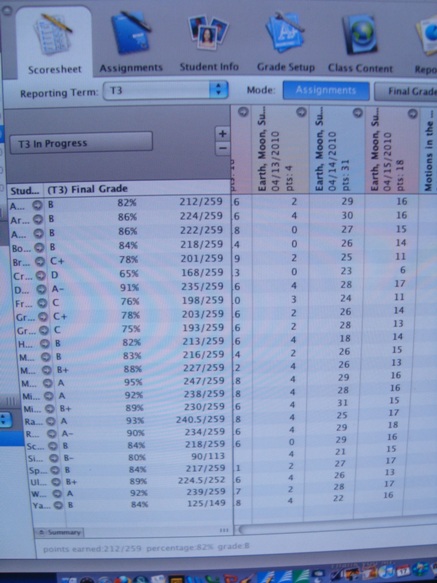
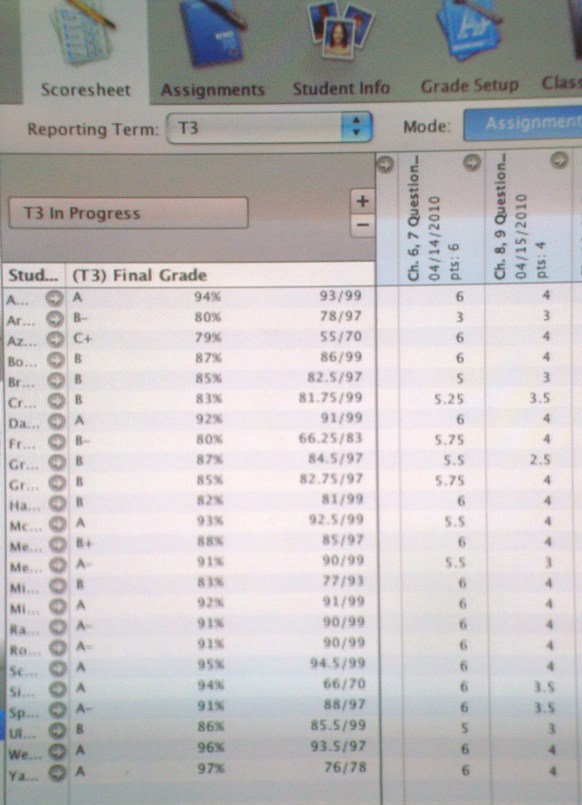
In order to keep track of my students' progress during my 4th grade student teaching placement, I entered their grades on the computer within a program known as PowerTeacher Gradebook. This program allowed for an easy tracking of their progress, in which I was able to view the class' grades as a whole and this helped me to see which topics were of difficulty. To see two brief examples of my records, you may click upon the following: science record and reading record.
E5 Manages student behavior in positive, safe ways.
INTASC 2, 5
NBPTS 1, 3
E6
Models
conflict resolution skills.
INTASC 2, 5, 8
NBPTS
1, 3
This 2nd grade lesson plan, concerning I-Messages, displays my ability to relate conflict resolution skills to students. It is important for all students to express their feelings; therefore, I feel that I could teach this lesson within any elementary grade level, so long as it was modified.
Using the book The Berenstain Bears get in a Fight, I created a literature activity that displays my ability to incorporate conflict resolution skills into a curriculum and classroom setting. Taking a closer look, I have two very important skills that are being taught within the activity: how to manager anger and how to help each other solve problems.
E7 Engages in research and reflection on best practices in teaching strategies.
INTASC 1, 2, 7, 9 NBPTS 4, 5
Nearing the end of my time at Manchester College, I was asked to reflect upon the last four years of my life and elaborate as to how I have grown as an educator. In order to gain an insight into how I think I have changed over the past few years, take a look at my final reflection paper.
I was able to make both personal and professional connections that demonstrated my ability to reflect on what I thought were some of the best teaching strategies and this was all done through a response letter.