Salaries and Benefits
“Whoever devotes himself to the university at Königsberg takes the vow of poverty.”
— C. J. Kraus (1753-1807) This quote by C. J. Kraus comes from a letter to Karl Ludwig Pörschke, who was applying to teach at the university. Pörschke would eventually be appointed as full professor of poetry there, and then full professor of practical philosophy after Kraus’s death [Voigt 1819, 436-7; repr. in Malter 1980, 174].
“What increases the evil of poverty is contempt, which cannot be completely overcome even by merit, at least not before common eyes.”
— Kant, Observations on the Feeling of the Beautiful
and the Sublime (1764) [AA 2: 213]
1. Salaries: [Königsberg salaries] [Kant’s salary]
2. Benefits
3. Extra Income
4. Investments
Salaries [top] [currency conversion]
Despite Kraus’s dire sentiment expressed above and which the historical record rather consistently vindicates, Kant denied having had any financial problems of his own – although the strength of this denial might in part stem from a sensitivity to his earlier poverty as a university student. Carl Johann Maria Denina (1731-1813) wrote a history of Prussian intellectual life that portrayed Kant as having come from a poor home and who had to support himself as a young lecturer by giving private lessons, and that he likely would have starved had not his friend Green invited him regularly to dinner [1790, 305-8]. In a letter to his one-time Berlin publisher François de la Garde, Kant asks de la Garde to extend his greetings to Denina but to please have him correct the misinformation in future printings of his book:
He has certainly been misinformed. For I have always had a full lecture hall from the very beginning of my academic career (in 1755) and never had to give private lessons [Privatinformationen] (it must be assumed he meant by that the privatissima seminar held in one’s own lecture room, and which is usually very well paid), consequently my income has always been ample, so that it sufficed not only for the rent on my two rooms and my very well laden table, without my having to ask for help from anyone, in particular not from my late English friend [Green] who was my regular dinner guest without needing any special invitation, and besides this I was always able to afford my own servant. Those were just the most pleasant years of my life. And a proof of this is that I turned down four invitations to positions at other universities during that period. Letter of 25 March 1790 [AA 11:146; Zweig transl., slightly modified]. Compare this with Christoph Friedrich Heilsberg’s account of Kant’s impoverished student days when he did tutor students for money, as well as play billiards [more] [Reicke 1860, 48-49; repr. in Malter 1990, 18-19]. There is also the comment in Rink [1805, 28] [text] that Kant took in a few students during his early years as a lecturer – but perhaps he did not give them any tutorials.
Kant’s income as a lecturer is unknown other than through Kant’s own general claims of self-sufficiency – although Jachmann reports in his biography that Kant’s lecturing income in these early years was “very small” and that he was forced to sell books from his small library to make ends meet [1804, 12-13], and Kant himself reported in a letter of 9 May 1791 to a former student, Sigismund Beck [bio], who was just beginning his teaching career at Halle, that “the pay from giving lectures is always very precarious.” “die auf bloßer Lesung von Collegien beruht, immer sehr mislich ist” [AA 11: 256]. A letter that Kant wrote to J. G. Lindner [bio] near the beginning of winter semester 1759/60 also suggests a financial strain:
For my part I sit daily at the anvil of my lectern and guide the heavy hammer of repetitious lectures, constantly beating out the same rhythm. Now and then I am stirred by some nobler inclination, a desire to extend myself beyond this narrow sphere; but the blustering voice of Need immediately attacks me and, always truthful in its threats, promptly drives me back to hard work. “Ich meines theils sitze täglich vor dem Ambos meines Lehrpults und führe den schweeren Hammer sich selbst ähnlicher [19] Vorlesungen in einerley tacte fort. Bisweilen reitzt mich irgendwo eine Neigung edlerer Art mich über diese enge Sphäre etwas auszudehnen allein der Mangel mit ungestühmer Stimme so gleich gegenwärtig mich anzufallen und immer warhaftig in seinen Drohungen treibt mich ohne Verzug zur schweren Arbeit zurück.” [AA 10:18-19; Zweig transl. (1999, 56)](full text)
There is also evidence that, in these early years as a Privatdozent, Kant was taking in students at the university and supervising their studies (somewhat in the manner of a Hofmeister – see Rink [1805, 28] [text]), and also giving private lessons to one or more nephews of Gräfin Kayserling [bio] – and possibly also to her two sons – at their Capustigall residence south of Königsberg [more].
The honoraria paid to Kant by students attending his lectures was 4 rthl. per student per class, but either he had very few students attending his classes, or else very few of these ever paid the honoraria. We know that Kant waived the honoraria for poorer students, but Voigt [1819, 437-38], in his biography of Kraus, claims that Kant, out of principle, generally required students to pay-up.
Kant’s first salary as a full professor was about 166 rthl. per year, which is less than the honoraria from 42 students in that year, or 21 per semester, or just 4-5 paying students per course taught. Kant appears to have finally enjoyed some financial stability with this salaried position, such that he gave up his lesser paying job as an assistant librarian (this was 62 rthl., or just 15 honoraria).
Apart from that, Kant would have drawn some earnings from his publications and, from April 1766 until April 1772, he received a salary of 62 rthl. (plus benefits such as firewood) for his work as the assistant librarian at the Royal Library (Schloßbibliothek).
The appointment letter from Berlin was dated 17 Feb 1766 and the installation order from von Braxein was dated 12 Mar 1766, and he began work on April 9; Kant’s resignation letter was dated 14 Apr 1772 [Warda 1899b]. Kant had petitioned King Frederich II for this position in a letter of 24 October 1765 [#30; AA 10: 48-49], which would “ease my rather difficult subsistence at the university here” [zur Erleichterung meiner sehr mißlichen Subsistenz auf der hiesigen Akademie].
See also his petition to Freiherr von Fürst u. Kupferberg, the current Oberkurator of the Prussian universities (29 October 1765; #31, AA 10: 49-50); in this latter petition, Kant notes that two other recent Magisters are also seeking the position – Martin Nikuta [bio] and Kant’s former student C. D. Reusch [bio], and then adds that such a position would “offer several advantages, such as having so many scholarly resources close at hand, as well as the small salary, which I understand to be 60 rthl., and which would help alleviate my very uncertain academic subsistence here” [Die erwünschte Gelegenheit, die ich in einem solchen Posten antreffen würde, so viele Hülfsmittel der Wissenschaften bei der Hand zu haben, imgleichen das kleine Gehalt, welches dem Vernehmen nach von 60 rtlr. sein soll, und meiner sehr unsicheren akademischen Subsistenz zu einiger Beihülfe dienen würde].
Once Kant was promoted to full professor (of logic and metaphysics) in 1770, he began to receive a steady salary of 166 rthl. 60 gr.
Cabinet order from Friedrich II [31 March 1770; #53, AA 10:94]. Stuckenberg [1882, 88] claims the salary to be 400 rthl., which Zammito [2002, 91] repeats, but the cabinet order is quite clear on this point.
Königsberg salaries [top] [currency conversion]
| Theol. | Law | Med. | Phil. | |
|---|---|---|---|---|
| 1st | 1000 | 800 | 800 | 750 |
| 2nd | 800 | 800 | 800 | 750 |
| 3rd | 450 | 450 | 800 | 750 |
Professors at Königsberg were paid according to the schedule to the right. Depending on the needs, there were sometimes more, sometimes fewer professors in the upper three faculty, and the salaries of any additional positions would range all the way down to zero. (For instance, A. W. Hardmann petitioned for a 4th chair in Law at Königsberg, and was offered the position in 1802 at a salary of 68 rthl., or 306 Marks). McClelland [1980, 83]. The total budget available to the university was 3329 rthl., 70 gr. This paid the professorial salaries, subsidized meals in the cafeteria, and helped pay salaries to the few non-academic employees [Goldbeck 1782, 26].
There were always eight professorships in the philosophy faculty, and each was paid 750 Marks – without any distinction of seniority – although the mathematics professor received an extra 50 Marks to help with the purchase and maintainance of special equipment [Arnoldt 1746, 1: 88-89; Goldbeck 1782, 25]. Zammito [2002, 24], working with figures from Turner and Hammerstein, claims that “the philosophy faculty earned salaries drastically inferior to those of the higher faculties,” but one can see from the table that this was not true of Königsberg. Apparently in Halle, the theology professors were paid 500 florins [= 750 marks, the same as philosophy faculty at Königsberg], but the philosophy faculty there received only 100 to 150 florins [= 150-225 marks].
In November 1769, Kant was offered a position at Erlangen [more] with a salary of 500 “Gulden Rheinl.” and five cords of firewood. If a “Gulden Rheinl.” is the same as a the Gulden and Florin mentioned elsewhere, then the base salary was identical to that for a philosophy professor at Königsberg, although in Königsberg one received sixteen cords of firewood rather than five (perhaps an indication more of the difference in severity of winters than of the generosity of the crown). In 1770, E. J. Danovius wrote to Kant regarding his possible interest in a new philosophy position created at Jena. [more] This came with a salary of 200 rthl., but Danovius noted that Kant could easily make an additional 150 rthl. per year from his private lectures. In 1778, Minister von Zedlitz urged Kant to accept a position at Halle [more] with a salary of 600 rthl., which he later raised to 800 rthl. in his attempt to lure Kant away from Königsberg.
Kant’s salary [top] [currency conversion]
| Date | Amount | Explanation |
|---|---|---|
| 1770 | 166 rthl., 60 gr. Pr. | Base pay for a full professor of philosophy |
| + benefits | (firewood, grain, etc.) | |
| = 236 rthl., 76 gr., 12 pf. | (for the years 1770-79) | |
| 1780 | + 27 rth., 75 gr. 10 pf. | Payment for serving in Academic Senate |
| = 264 rth., 62 gr. 4 pf. | (1780-85) | |
| 1786 | + 100 rth. | Senior member of faculty |
| = 364 rth., 62 gr. 4 pf. | (1786-89) | |
| 1789 | + 220 rth. | Special order of the King |
| = 584 rth., 62 gr. 4 pf. | (1790-1801?) |
Warda [1901] reports that Kant’s salary was “166 rthl. 60 gr. Pr.”. Using the conversion table, one sees that this is equivalent to exactly 750 Marks (likewise with the “500 Prussian Gulden” that is occasionally mentioned). Zweig [1999, 103] interprets the “gl. Pr.” to mean “Prussian goldpieces,” although this is rather more likely to be understood as Prussian Groschen.
Warda also calculated the various benefits included with Kant’s base salary, which brought the total value to 236 rthl., 76 gr., 12 pf. (making the benefits worth roughly 30% of the total). Upon entering the academic senate in 1780, Kant received the additional annual salary of 27 rthl., 75 gr. 10 pf., Heilsberg, in a questionnaire sent him by Wald, wrote that “in the court rescript of August 11, 1780, concerning Christiani’s vacant position, it reads: ‘Wir wollen dem jede Verbesserung so sehr verdienenden Prof. Log. & Met. Kant die vacant gewordene Stelle im academisch. Senat mit den dabey aufkommenden Emolumenten a. 27 Thlr. 75 gr. 10 pf. hiemit conferiren und darin bestätigen.’” [qtd. in Reicke 1860, 52]. and upon becoming the senior member of the faculty he received an additional 100 rthl. per year (for an annual salary of 364 rthl., 62 gr., 4 pf.). Kant served twice as rector, and the holder of this office received various additional benefits totaling about 100 rthl., as well as one-half of all the matriculation fees that they brought in during the semester The matriculation fee in Königsberg was 2 rthl. for normal citizens, and 4 rthl. for children of nobility. The other half of this fee (which amounted to about 150-180 rthl. per year) entered the university treasury, and was used primarily for maintenance of the buildings [Goldbeck 1782, 49]. and money for giving their imprimatur to any printed matter that passed the censorship of the academic senate [Goldbeck 1782, 49]. Kant was given a raise of 220 rthl. in 1789 by special order of the Berlin government, Flittner [1824] claims this was tied to Kiesewetter’s [bio] visit to Königsberg to study with Kant (arriving 10 Nov 1788); Kiesewetter was a favorite of the court. and by the end of his career his salary (including all the benefits) was 749 rthl., 23 gr., 9 pf. He may have forfeited some of this salary once he gave up his professorship in 1801; see the discussion of his retirement. In 1804, at his death, his estate was worth 21,539 rthl., 33 gr., 12 6/11 pf. This figure comes from Rahden [1901, 91], which both Warda [1901, 424] and Stuckenberg [1882, 447] repeat. Wasianski gives Kant’s wealth (in 1798) as 14,310 rthl. (42,930 florins), citing his will, “not including the house and furniture” [1804, 83-84]. Warda’s calculations were improvements on Fromm [1894, 62-64]. To his annual income would need to be added the student honoraria from his private lectures and privatissima, R. B. Jachmann [1804, 185-87; 1912, 198-99] discusses Kant’s income briefly, and from his brother (who spent more time caring for Kant’s finances) reports that Kant was likely making more from the honoraria of his private lectures than he was from his salary, at least in his later years; also that he was drawing 6% interest on money invested with Green and Motherby. and the royalties from his publications. Vorländer [1924, 2: 81-83] discusses Kant's honoraria from publications, noting that Kant received 4 rthl. per sheet for the Critique of Pure Reason (or 220 rthl. altogether). His highest royalty was for his little Perpetual Peace, and for which he received 10 rthl./sheet. McClelland [1980, 86] suggests that writing journal articles was a significant supplemental source of income for junior faculty. Junemann [1909, 25-53] provides an extensive discussion of Kant’s literary honoraria.
It is often hard to know what to make of these figures, although one can at least say that, by the end of his career, Kant was the best paid professor of philosophy at the university.
A common method for assigning values to these figures is to consider what a Reichsthaler would purchase back in Kant’s day (on this see also the more detailed discussion on student expenses). A government regulation of 1735, for instance, claimed that a student should be able to subsist on 40 rthl. per year (or about one-sixth of Kant’s starting salary as a professor, once benefits are figured in). Ludwig von Baczko [bio] paid 60 rthl. per year for his room, board, and heating while he was a student in the early 1770s. A coat and vest (in Kant’s student days – so, the 1740s) cost 8 Gulden 22 1/2 Groschen (= 2 rthl. 82 gr. 9 pf.) [Vorländer 1924, 1: 46]. Johann Gottfried Herder [bio] showed up in Königsberg in the summer of 1762 with only 3 rthl. 8 gr. in his pocket, two rthl. of which paid his matriculation fee; while studying he found a job teaching at the Collegium Fridericianum, where he received free room and board and 16 rthl. per year (eventually raised to 50 rthl. per year). A stipend that he had applied for and received (from the Dohna family) paid out 50 Gulden (= 16 rthl. 60 gr.) per semester [Dobbek 1961, 83-85]. It cost a student 50 rthl. just to graduate from the Albertina, and when they did graduate, that money was divided nine ways: 2 rthl. to the government minister, and 6 rthl. to each of the eight philosophy professors.
Kant bought his first (and only) house at the end of 1783 (December 30) for 5500 gulden (= 1833 rthl. 30 gr.) [Springer 1924, 14]. His annual salary (without benefits included) was 194 rthl. 45 gr. 10 pf, so the purchase price of the house was 9.4 years of his base salary (although of course he was also drawing income from student honoraria and royalties). In any event, Kant had enough money saved that he was able to pay off the mortgage by July 1784.
Benefits [top] [currency conversion]
Warda calculated the monetary value of Kant's starting “benefits” at 70 rth., 76 gr., 12 pf. But what form did these benefits take? Firewood and grain were likely the most significant. The wood was delivered from the royal forest at the rate of five Achtel per year to each of the first two professors of theology and law, the first three professors of medicine, and all eight professors of philosophy. An Achtel equals 12 cubic meters or 3 1/3 Klafter, and a Klafter a bit smaller than a “cord,” the standard unit for firewood in the US. So each professor received over 16 cords of firewood each winter.
Each member of the Academic Senate (i.e., the top two professors in each of the higher faculties, plus the four most senior professors in the philosophy faculty) received one Last and twenty Scheffel of rye, while the third professor of Medicine and the four younger professors of Philosophy received 44 Scheffel of rye [Goldbeck 1782, 51-52]. According to Engel [1965, 8-9], a Last is equivalent to 48 Scheffeln, and one Scheffel is equivalent to about 40 kg of rye or 36 kg of barley. Schubert also claimed that the grain included barley and peas along with rye, and that they came in the following ratio: 10/13 rye, 2/13 barley, and 1/13 peas [1859, 69].
Perhaps of more significance for Kant scholars, each senator was given free use of an amanuensis [glossary], insofar as they were given rights to one place at the university cafeteria for the price of an alumnus (namely, 2 groschen per week).
All full professors also received an annual Accisevergütung (which appears to be a rebate on taxes for imported goods) of 80 Gulden, and they were allowed to brew one tax-free Bräusel of beer per year [Arnoldt 1746, 2: 114]. To cap it all off, full professors were given a free burial, as were their widows and any unmarried children [Goldbeck 1782, 40-42].
Extra income [top] [currency conversion]
Side teaching positions. Many professors were forced to take on outside employment to support themselves, especially at some of the more underfunded schools which often would simply fail to pay the salaries. It was fairly typical for professors of medicine to carry-on a private practice on the side, and for professors of law to do likewise. Professors of theology often held pastoral positions at a local congregation. Goldbeck discusses the advantages for professors to hold second jobs as rectors or teachers at local Latin schools [1782, 178-79]. Kant noted in a letter to Jakob Sigismund Beck [bio], a former student of his considering a teaching position at Halle, that “since the subsistence from lecturing is always very precarious, you should at the same time look for other teaching positions in your area at a high school, so as to be better able to provide for your needs” [9 May 1791; AA 11:256, #469]. Writing books and articles also generated some income.
University Offices. At Königsberg there were also additional paying positions within the university, such as those of head librarian and assistant librarian in the university library. While teaching as a lecturer, Kant applied for (24 Oct 1765) and received (14 Feb 1766) the position of assistant librarian, which he kept until 25 Jun 1772. Kant’s written request was dated 24 Oct 1765, a letter (16 Nov 1765) from the local government to the Academic Senate requested that Kant be given a position when one becomes available. Kant was formally given the position (14 Feb 1766), he began (9 Apr 1766), and upon his request was relieved (25 Jun 1772) from the position; documents in the Staatliches Archivlager, Göttingen, EM 71.1 53d. Until he received his appointment as full professor in 1770, this was his only steady income. The hours at the library were not demanding, as it was open only two days a week (Wednesday and Saturday), and then only in the afternoon from 1 until 4. Apparently it did not open at all in the Winter because the two rooms where it was located could not be heated. For this Kant was paid 62 Thaler per year, plus emolumente (e.g., firewood). Gause [1974, 22]. Elsewhere Gause suggests that it normally was open in the winter, since he noted that one winter it was kept closed because the head librarian didn’t like to work in the cold. Kuehn [2001, 159] describes Kant working in the winter “with stiff hands and frozen ink in dark rooms, which did not allow reading or writing at all.”
Faculty also received various incidental incomes when serving as rector or as dean of one of the faculties. As noted above, the rector received about 100 rthl. in various fees, as well as one-half of all matriculation fees during their semester. Scholarships generally required the regular testing of the recipients, and the examiners would be compensated for this; for instance, the Gröben scholarship required testing every six months, which involved the rector and the deans of the philosophy and law faculties. For this the rector received 20 Gulden and each dean 15 Gulden (per exam).
We find that Professor Reusch [bio] was paid 88 rthl., 40 gr. and given free lodging to serve as the inspector of the Alumnat [glossary] and Collegium Albertinum in 1780. W. B. Jester [bio], a professor of law and chancellor of the university, was paid 58 rthl., 60 gr. as a stipendium curator [Euler 1994]. G. D. Kypke [bio], professor of oriental languages, was paid 100 fl. (= 33 rthl., 30 gr.) to serve as inspector of the local synagogue, which involved attending all the services. See Wendland [1910, 29]. Dietsch claims that the honorarium paid out was 100 rthl./year [1994, 117]. Kypke was also known for his garden, out of which he sold carrots and onions – and yet this frugal, bachelor professor was able to endow a dormitory for poor students with an estate worth 50,000 rthl. (the Kypkeanum).
Honoraria. Publishing was another source of additional income (as noted above, in Kant’s case).
Taking in Students. Gause writes [1996, 2: 244n] that …
“many professors supplemented their income by taking in foreign students. In 1739 not fewer than fifteen young nobility were living with professor Coelestin Kowalewski [bio], among whom were Friedrich Freiherr von der Trenck (1726-1794), who later became famous through his adventurous life.”
As mentioned above, Kant apparently took in a few students in his early years as a Privatdocent; since he was renting rooms himself from Prof. Kypke, Kant was presumably serving as something like a Hofmeister for them, offering them help with their studies and supervising their living arrangements – see Rink [1805, 28] [text]). Several sources also claim that Kant, in those early years, was giving private lessons to one or more nephews of Gräfin Kayserling [bio] – and possibly also to her two sons – at their Capustigall residence south of Königsberg [more].
Finally, we know that Kant was also investing his money in the firm of Green, Motherby & Co., and that these investments grew nicely over time. This is discussed more fully in the section below.
“Kant’s favorite place to socialize was at an English merchant's house [Joseph Green’s] to whom in later years he had given the entire fortune at his disposal for investment.”
— C. F. Heilsberg Quoted in Reicke [1860, 49]. On Heilsberg, see his [bio].
“… not a single unjust penny could be found among it.”
— L. E. Borowski Borowski [1804, 141]. On Borowski, see his [bio].
Investments [top] – [currency conversion]

F. C. Jacobi
What about Kant’s investments?
The following paragraphs on Kant’s investments in sugar have benefited from ongoing conversations with Werner Stark, Garrath Williams, and Jennifer Mensch (2024).
We actually know a fair bit about this because they are listed under “Title II” of the official inventory of Kant’s estate, prepared and signed by Justiz-Commissarius Johann Friedrich Radtke [bio] on 17 September 1804, a copy of which came to light in 1901 and is still available to us.
Cf. Rahden [1901, 84] [pdf]. Shortly after Kant’s death on 12 February 1804 copies were made and distributed to Kant’s principal heirs – his eight nieces and nephews – with a main copy (Haupt-Exemplar) prepared for Wasianski as the will’s executor (executor testamenti). Near the top of published copy of the inventory is written ‘Neben Exemplar’ (duplicate copy) and was most likely the copy given to Friedrich Wilhelm Kant, a son of Kant’s younger brother and the seventh named heir. (Title VIII of the inventory itself gives a breakdown of the cost of preparing those nine copies.) In the 1901 report documenting the discovery of the inventory, we read:
“Baron Alexander von Rahden presented a copy, procured by him, of the inventory of Immanuel Kant’s estate for publication in the Sitzungsberichte; he had found this in the estate of the famous Königsberg philosopher’s grandniece – Miss Emma Kant – who died in Mitau on 10 November 1898. In accordance with her last will and testament, the inventory along with other Kant relics are to be transferred to the Curland Provincial Museum.” [Rahden 1901, 36] Emma Charlotte Benigna Kant (1826-1898) was the youngest and last surviving child of Friedrich Wilhelm Kant (1781-1847), the fourth and second youngest child of Kant’s younger brother, Johann Heinrich Kant (1735-1800).
So to reiterate: the text published in the society’s minutes (a pdf of the full report and inventory is available here) was from a copy prepared in 1900 of the 1804 copy. This is relevant for understanding what appear to be copy errors in the published inventory (e.g., on p. 86, Samuel Kroenert’s auction purchase reads “297 rthl.”, but should read “297 fl.” since it is to equal 99 rthl.).
We know that about one-fourth of Kant’s invested wealth was with a local sugar refinery [glossary] – the first in Königsberg – and because the raw sugar being processed in this refinery came from the West Indies, it was probably the product of slave-labor.
One might question this by raising the possibility that this new sugar refinery was instead processing locally grown sugar beets, and thus was not part of the slave economy – but that is not the case. Although the sugar beet had recently been identified as a potential source for refining sugar, the cultivation and refining of sugar beets was not well-established until several decades into the next century. A nice overview of this story and the work of the German chemist Franz Karl Achard (1753-1821) is provided in a 1799 review [pdf] of the pamphlet The Newest German Substitute for Indian Sugar, or, Sugar from the Sugarbeet. The most Important Discovery of the 18th Century. Berlin: Oehmigke, 1799 [44 p.]. For a recent discussion of the transition from cane to beet sugar as an abolitionist strategy against slavery, as well as of the above pamphlet (whose author is identified as Daniel Friedrich Rumpf), see Lentz [2022].
In addition to the above, the few sources discussing the Königsberg sugar refineries – the early refinery in which Kant invested as well as two others built in the early 19th century – either explicitly state that they were processing cane sugar or that it was precisely the introduction of sugar beets that brought about their financial ruin. Meier writes [1864, 421-22]:
“The sugar refineries so [422] important for Königsberg were a victim of the protective tariff for beet cultivation and beet sugar. Their beginning was based on a monopoly and preferential taxation, which also led to their demise.” [pdf]
and Armstedt [1899, 250]:
“While the Königsberg merchants rightly opposed these monopolies [for tobacco and salt], they had no qualms about granting themselves a [250] monopoly for sugar boiling in East Prussia and Lithuania (8 July 8 1782). A company was formed to set up a sugar refinery, and as early as 1784 (March 10) the import of all foreign sugar was banned. Although the privilege was revoked in 1789 in return for a compensation, the sugar refinery continued to flourish and did good business, only to be replaced by beet sugar.” [pdf]
Gause explicitly notes that this first refinery, as well as two more that were begun in the early 19th century, were processing cane sugar; the second of these tried to make the conversion to beet sugar, but failed, and all three were closed by 1872 [1996, 2: 207, 436-37]. See also the following note.
It is also probable that Kant was fully aware of the nature of these investments, since he was on familiar terms with one of the owners of the refinery, the banker Friedrich Conrad Jacobi [bio]
Our only information regarding ownership comes from Gause, who offers a very brief account as part of his three-volume history of Königsberg [1996, 2: 207]:
“Frederick the Great was more successful in his efforts to establish refineries for processing sugar cane and thereby restrict the import of sugar. The first refineries in Prussia were built in the 1740s. In 1782, Frederick recommended to the president of the Königsberg Chamber that a refinery should also be set up in Königsberg. A merchant named Straube agreed to do so, but nothing seems to have come of it. In the same year, however, Johann Friedrich Wilhelm Farenheid, a war- and domain councilor, sold a large plot of land he had inherited from his father, Reinhold Friedrich Farenheid, to the “Royal Prussian Monopoly – East Prussian and Lithuanian Sugar Refinery” for 15,000 guilders. This first Königsberg refinery was founded by the banker Friedrich Konrad Jacobi with a merchant Weiland Degen. Their technicians were brought in from Holland and Hamburg. The partners were granted a monopoly on sugar boiling in East Prussia. Although it was lifted in 1789, the refinery continued to do good business. Several other refineries were established in Königsberg in the 19th century. We will talk about them later.” Gause discusses this and two additional sugar refineries later in the same volume where, among other things, he notes that Georg Karl Bittrich (1795-1866) opened a second refinery on the Weidendamm in 1829 and some time later (no date given) Pollack opened a third on Königstrasse. The Jacobi factory closed in 1862, the Pollack in 1869, and Bittrich in 1872 (pp. 436–37). Albinus [1985, 348] also includes a brief entry on sugar refineries in Königsberg:
“1782 errichtete die Königsberger Kaufmannschaft in der Vorstädtischen Hospitalstr. eine Zuckersiederei und -raffinerie. Eine weitere derartige Raffinerie gründete Georg Karl Bittrich 1829 am Weidendamm, die aber 1869 der Konkurrenz des Rübenzuckers erlag.”
– or rather, it is probable, but only if this was all done when Kant was still managing his own financial affairs.
It seems more likely, however, that these investments in the sugar refinery were not made until after Kant had given over the handling of his financial affairs to his friend Wasianski [bio]. An earlier draft of this section was written before 2026 and under the assumption that Kant had made these investments in the 1780s; I’ve since had time to read the relevant documents more carefully. More on this below.
The most succinct account of Kant’s investments appears in a letter of 17 February 1804 from Kant’s friend and executor Wasianski to the family of Kant’s younger brother Kant’s brother Johann had died four years earlier in 1800 as the pastor in Alt-Rahden (present-day Vecsaule, Latvia, which is some 350 km northeast of Königsberg and about 70 km south of Riga). His widow Maria was still living, as were their four children – three married daughters and a son. Wasianski sent his letter to the husband of Kant’s niece Amalie Charlotte Kant (1776-after 1826), Johann and Maria’s oldest child, who was married (1797) to Carl Wilhelm Rickmann (1766-1830) – listed as ‘Rieckmann’ in Radke’s inventory – a notary and city secretary in nearby Bauske (Courland). Wasianski wrote to Rickmann because he thought Rickmann was the oldest male member (although by marriage) of that family – unaware that the older Friedrich von Stuart (or ‘Stuard’) had already married into the family the previous March — and so it was to Rickmann that Wasianski, acting as Kant’s executor, wrote with information regarding Kant’s estate and funeral arrangements, and the request that this information be shared with the rest of the family. The investments and their values provided here by Wasianski match those given by Radtke in his official inventory [1901, 84] [pdf]. to let them know of Kant’s estate and of the pending funeral arrangments. Wasianski listed four investments, along with the cash and an estimate of the value of Kant’s house [see] – the amounts are in Guldens/Florins (fl.), which had the value of 1/3 Reichsthaler (rthl.):
(1) A bill of exchange (Wechsel) from the trading house of Green Motherby et de Drusinna: 21,500 fl. [= 7166 rthl. 60 gr.]
Kant’s investment with Green, Motherby & Co. on 26 Feb 1798 (when he wrote his will) was 42,930 fl. (=14,310 rth.). Six years later it is roughly half that amount (21,500 fl.), but 10,000 rthl. was transferred into the other investments listed in the inventory (the mortgage and the two bonds); showing an overall increase in capital of 8,570 fl. (=2856 rthl. 60 gr.) during those six years.
Mention of this principal investment appears occasionally in Kant’s correspondence and notes. If a due-date is ever given, it is either January 1st or July 1st. A distribution of the interest is mentioned in Kant’s 1 Jul 1802 letter to Joseph Motherby (written by Wasianski, with Kant’s signature):
“645 fl., written Six Hundred and Forty-Five Guilders, [the] six-month interest at 6%. from a capital of 21,500 guilders, has been paid to me correctly and in cash by the wholesale merchant [Negotianten] Mr. Joseph Motherby, for the half year from January 1 to July 1 of the year 1802; for which I gratefully acknowledge with my own handwritten signature. Königsberg, July 1, 1802.” [Stark 1993, 238]
“645 fl. schreibe Sechshundert und Fünf und Vierzig Gulden halbjährige Intereßen zu 6. p.c. von einem Capital von 21 500 fl., sind mir von des Negotianten Herrn Joseph Motherby HochEdelgeboren für das halbe Jahr, vom 1. Januarii bis 1 Julii des Jahres 1802 richtig und baar ausgezahlet worden; worüber mit eigenhändiger Unterschrift dankbar quittire.”
In Robert Motherby’s letter (27 June 1799):
“Now, please allow me – since July 1, the deadline for the renewal of the old bill of exchange from 1798 and the issuance of the new one for 1799, is approaching – to take the liberty of submitting the draft for your review and approval … [A detailed statement of account follows for a bill of exchange amounting to 48,398 guilders.]” [Schöndörffer 1986, 951]
“[…] Nun erlauben Sie mir: da der Erste July, als der Termin der Renovirung des alten Wechsels von 1798 und die Ausstellung des neuen für 99 herankommt; daß ich mir die Freyheit nehme den Entwurf dazu, zu Ihrer Übersicht und Billigung, hiemit Ihnen vorlege … [Es folgt die detaiillierte Rechnung für einen Wechselbetrag von 48398 Gulden.] […]”
Likewise Wasianski’s entry for 31 December 1801 in Kant’s “dinner diary”:
“Joseph Motherby wishes to correct the professor’s bill and to find out whether the bill of exchange should be extended and whether the Deacon [Wasianski] is here.” [Stark 2024, 42]
“Joseph Motherby wünscht die rechnung des Herrn Professor zu berichtigen und zu wiß ob der Wechsel prolongirt werden soll und wenn Herr Diac. hier anzutreffen ist.”
We find similar comments scattered among the pages of the Opus postumum notes, such as:
“Tuesday: Joseph Motherby and Dr. [William] Motherby are dining with me today. New bill of exchange on top of the desk. Is it dated January 1802? Cabliau with thick butter and potatoes. – Renew the bill of exchange in the top drawer.” (Jan 1802?) [AA 21: 125]
“Dienstag Joseph Motherby und D. [William] Motherby speisen mit mir heute. Neuer Wechsel [“bill of exchange”] Oben auf dem Bureau. Ob er vom Januar 1802 datiert werde Cabliau mit dicker Butter Cartoffeln. – Den Weschel zu renoviren in der oberen Schublade”
–––––
“When drawing up the bill of exchange, set aside approximately 1,000 florins ‘De Trosina’ [De drusina] after deducting all debts and pay out that amount. The bill of exchange (excluding ‘De Trosina’) should specify a sum sufficient both to settle the debts listed in the calendar and to allow for discretionary charitable contributions.” [AA 21: 129]
“De Trosina bey Abfassung des Wechsels etwa 1000 fl nach Abzug aller Schulden abzusondern auszusahlen. Der Wechsel (ohne de Trosina) bey dem Wechsel sich eine Summe auszumachen um so wohl die im Calender notirte Schulden abzutragen als auch aus freyer Hand wohlthätig zu seyn.”
–––––
“The bill of exchange transaction has been fully settled.” [AA 21: 130]
“Das Wechselgeschäfte ist völlig berichtigt.”
–––––
“A new bill of exchange is coming on New Year’s Day.” [AA 21: 139]
“Auf Neujahr kommt der neue Wechsel.”
Finally, in a discussion of Kant’s growing inability to sign his name, Wasianski writes:
“He could no longer see the letter he had just drawn only by feel and his memory was so weak that he forgot the letter he had just drawn, which would not have been the case had he been able to see it. Even reciting the letters was no use, for he lacked the imagination to picture their shape. Already by the end of November [1803] I saw this fate hastening towards him, so I wrote out in advance the receipts for the interest that would fall around the New Year, and he signed his name quite neatly under them.” [1804, 190]
“Er sah den Buchstaben nicht mehr, den er gemacht hatte und sein Gedächtniß war so schwach, daß er den Buchstaben, den er nur nach dem Gefühl zeichnete, wieder vergaß, welches, wenn er ihn noch hätte sehen können, nicht der Fall gewesen wäre. Auch das Vorsagen der Buchstaben war von keiner Wirkung, denn es fehlte ihm an Einbildungskraft, sich die Figur derselben vorstellen zu können. Schon am Ende des Novembers [1803] sah ich dieses sein Schicksal schleunig auf ihn zueilen. Ich schrieb daher die Quittungen für seine um Neujahr fallenden Zinsen schon um diese Zeit und er zeichnete seinen Namen noch recht sauber unter dieselben.”
(2) A bond (Obligation) on Garbenincken: Garbenincken was the name of an estate in the area; Kant held the 18,000 fl. balance of the purchase price left unpaid by Major von Bronsart in 1792, registered (ingrossirt) against the estate and assigned (cedirt) to Kant. 18,000 fl. [= 6000 rthl.]
(3) A bond (Obligation) on the sugar refinery: 6,000 fl. [= 2000 rthl.]
(4) (ditto): 6000 fl. [= 2000 rthl.]
Total: 51,500 fl. [= 17,166 rthl. 60 gr.]
(5) Cash on hand: 500 fl.
Total: 52,000 fl.
His house is debt-free and cost him 6000 fl., plus remodeling expenses of 2000 fl. If the same sum comes from the sale: Wasianski is probably misremembering the purchase price. Karl Springer (1867-1928), a city auditor in Königsberg, made close use of the city archives when writing short pieces on the city; in his Kant und Königsberg (1924, 14) after reciting a summary history of previous owners of Kant’s house, he notes that Kant bought the house on 30 Dec 1783 from the widow of the portraitist Johann Gottlieb Becker for 5500 guilder. Becker had purchased the house 24 Mar 1752 for 6860 fl. (an inflated price, as it had earlier that year been bought for 3100 guilder). In 1804 Kant’s house sold at auction for 3370 rthl. (or 10,110 fl.) on 27 April 1804 to the local merchant Johann Christoph Richter [Rahden 1901, 83]. Richter then sold the house for the same price to the innkeeper Johann Ludwig Meier [Springer 1924, 18]. 8000 fl.
Grand total: 60,000 fl. [20,000 rthl.]. [Lehmann 1966b, 83] [pdf]
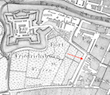
Detail from 1809 map
The sugar refinery investment, which took the form of two bonds
‘Schuldverschreibung’ is the term used in the official inventory prepared by Radtke. While a small point, it is worth noting that Kant did not hold shares (Aktien) in this refinery, as was claimed in the display on Kant and colonialism in Bonn (2023) and referred to in Williams [2025, 52] – he was not a shareholder or part owner of the enterprise, and he assumed none of the risks of ownership or corresponding profits that characterize shareholders; he was simply loaning money to the company at a fixed interest rate. (Whether a moral difference can be found in this is a separate question.)
– each worth 2000 rthl. and with an interest rate of 5% – was trivial for neither Kant nor for the refinery, being 1/4th of Kant’s invested wealth and the equivalent of 1/25th of the company’s start-up capital.
Meier [1864, 421] [pdf]:
“As a result of this privilege, a group of Königsberg merchants established a partnership on 29 November 1782 to set up a sugar boiling plant. The share capital amounted to 100,000 Thlr. in 1000 shares of 100 Thlr. each. In 1784, the company had completed its business far enough that on March 10, the import of all foreign sugar for domestic consumption was prohibited. The license granted to the sugar refinery in Königsberg was extended in 1785 to allow the company to import foreign sugar for the time being until it was able to supply the provinces with its own products, without the supplementation of the foreign sugar.”
This was only the second chartered shareholding business established in Prussia; the first was created twelve years earlier in Breslau, and was also a sugar refinery [Thieme 1960, 292] – my thanks to Garrath Williams for this reference.
As Meier mentions in the quote above, shares in the sugar refinery cost 100 rthl. each, but Kant would not have been able to purchase these. The local historian Baczko [bio] reported that only Königsberg merchants were allowed to own shares [1804, 402] [pdf]:
“The sugar boiling plant was established in 1782 by shares from the local merchants. Anyone who is not a merchant is excluded from owning these shares. The shares soon increased in value due to their considerable dividend. The buildings of the sugar refinery have recently been enlarged. The first factory owners came from Hamburg and Holland. In 1802 the factory employed 53 workers; consumed 200,000 Thaler worth of raw materials; produced 220,900 rthl. worth of refined sugar, of which 185,000 rthl. remained in the country.”
A report by a Russian traveling through Königsberg and Prussia in 1814 claims that this sugar refinery had the “remarkable stipulation” that “scholars and Jews are not allowed to own shares” [Rauschnick 1817, 117]; my thanks to Joris van Gorkom for pointing out this passage.
The refinery was built just east of the large park surrounded by an embankment called the “Philosopher's Walk” where Kant and a great many other citizens would take their daily stroll (see the detail from the 1809 Paulus Schmidt map of Königsberg). It received its license to begin operations on 14 October 1782, but Kant likely did not invest in the company until near the end of his life, some time after he wrote his “Last Will” (26 Feb 1798) in which he mentions a single investment among his assets:
II. the movable consists at present of a capital lent out at 6 percent interest to the trading house Green, Motherby & Co., in a bill of exchange on the said house, due on 1 July 1798, for 42,930 fl. [14,310 rthl.]
| Date | Amount (fl.) | Document |
|---|---|---|
| 1798 (Feb. 26) |
42,930 | Kant's last will [AA 12: 384] |
| 1799 (Jul. 1) |
48,398 | R. Motherby to Kant [Schöndörffer 1986, 951] |
| 1802 (Jul. 1) |
21,500 +30,000 |
Kant to J. Motherby [Stark 1993, 238] |
| 1804 (Feb. 12) |
51,500 | Estate inventory [Rahden 1901, 84] |
This bill of exchange with Green, Motherby & Co. was at 6%, while Kant’s bonds with the sugar refinery were at 5%, so it is unlikely that the latter were somehow part of the former. Radtke’s description in the estate inventory makes it clear there were three distinct investments: (1) with Green, Motherby & Co. (Wechsel; a bill of exchange), (2) with the sugar refinery (Schuldverschreibung; two separate bonds), and (3) with the Garbenincken estate (similar to a mortgage, acquired by Kant and with a 5% interest attached).
Vorländer, who would have also been drawing from the Radtke inventory, retains this division into three pots in his brief description of Kant’s investments:
“The assets were invested in the Green and Motherby trading house (at 6%), in a mortgage [Hypothek] on the Garbenincken estate, and in the Königsberg sugar refinery, i.e., fairly equally in trade, agriculture, and industry, and these had increased in the last six years from 42,930 to 52,987 guilders.” [1924, 2: 339]
These two additional investments were added some time after 1798 (the writing of Kant’s will), and quite likely after 8 November 1801, the date when Wasianski assumed control of Kant’s finances, as recounted in his 1804 biography:
Wasianski writes [1804, 78]:
“With his delicacy and the most careful avoidance of causing any inconvenience, he entrusted me with his entire affairs, just as I never did more than he asked of me or what he had freely granted me, namely, to make whatever suggestions I had that might improve his situation, even without being asked. In November 1801, he made me aware of his wish to completely dispose of his property and everything that might have any connection to him, and to retire [in Ruhe zu setzen], as one says. He told me this [79] little by little, first asking me for the kindness of going through his cash on hand and dividing it according to the different kinds of coins. Apparently some unusual but by him not easily explainable event had occurred with the money. He gave me the keys to what he called his shrine, to carry out this request, and then went into the other room. I was embarrassed by this new proof of his confidence, because it was not unknown to me that in this cabinet were the papers relating to his property, the contents of which he kept secret. He soon returned and offered me the [1784 Abramson gold] medallion minted for him as a souvenir, and also gave me a written deed of gift [dated 8 November 1801 and reprinted at AA 12: 392] in order to protect his servants from any suspicion of theft after his death.”
In his autobiography, Kant’s old friend Scheffner [bio]
mentions this relationship that Kant had arranged with Wasianski [1816, 399-400]:
“A year before Kant’s death we talked about domestic matters, and [400] he asked me if I did not at times want to get a Wasianski. ‘You would not believe how excellent it is to have found a friend to whom one can leave all one’s household affairs, with the full conviction that he will manage them as if they were his own,’ but I was no more of the opinion then as I am now, of our philosophical patriarch, and have managed my small domestic affairs until just recently, since I consider even the decision to such abandonment a sign that the great final weakness stands on the threshold, and one must seek to avoid or deflect this as long as possible. In the demands of duty and its performance, cannot friendship be misused as a domination? Will not this humiliate the master as well as the servant?”
Kant wanted to retire, to have nothing more to do with his property, and he agreed to allow Wasianski to include Vigilantius [bio], Kant’s personal lawyer and friend, in all the deliberations of handling Kant’s finances – and at this point Wasianski throws some light on the history of Kant’s investments:
“I found it necessary to move his money to another location and into another cabinet, storing it in sealed and labeled bags,
This refers to the cash that Kant kept locked up in the cabinet in his bedroom, along with the table silverware; Wasianski now used two boxes, each with a key that remained in Kant’s possession, and with the bulk of the cash in one box, with Wasianski transferring small amounts to the other box to cover daily expenses.
and take the liberty here of interrupting the narrative to [84] justify this precaution. According to his will, Kant’s estate in 1798 amounted to 42,930 guilders, or 14,310 thalers, not counting his house and personal property. Since that time, the income from his writing and his lectures had been almost negligible, because he was now neither writing nor lecturing.
Another close friend and earlier biographer of Kant’s – Reinhold Bernard Jachmann [bio] – saw this differently:
“For many years I thought that his investments with his friend Green was the foundation for his later wealth, but my brother [bio],
who was in charge of his finances for several years, claims that in later years he made more from his private lectures [186] than his salary, even after Friedrich Wilhelm II increased it by 200 Rthl.; the frequent editions of his writings also earned him a lot of money, as well as the small sum he gave to Green and Motherby early on at six percent interest that was always reinvested and to which he added each year from his savings.” [Jachmann 1804, 185-86]
A capital of 10,000 thalers, which had been out at 6 percent with the house of Motherby, was paid in and could be lent out again only at 5 percent against registered (mortgage) security; this produced an annual shortfall of 100 thalers in interest. He spent an additional 200 thalers annually to support his relatives, and as his health declined, his expenses increased. Lampe continued to receive 40 thalers annually after his dismissal, and at the time of his death, his capital in money [baares Geld] still totaled over 17,000 thalers.”
The “over 17,000 thalers” refers to Kant’s capital assets (despite Wasianski describing it as “baares Geld”); it cannot be the cash on hand, since “at the time of his death” there was only 191 rthl. 10 gr. (This agrees with Wasianski’s numbers in his letter to Rickmann, presented above, where he totals the capital investments at 17,166 rthl. 60 gr.) Warda [1901, 427] also remarks on this claim: “Wasianski meint die ausstehenden Forderungen.”
[Wasianski 1804, 83-84; my emphases]
Of particular interest here is the cashing out of 10,000 rthl. of the bill of exchange with Green, Motherby, & Co. It is striking that this is the total amount later invested in the Garbenincken mortgage (6,000 rthl.) and the sugar refinery bonds (4,000 rthl.), both at the same reduced interest rate of 5%. Is it not likely that Wasianski is describing this very reinvestment here?
Radtke describes the two sugar refinery bonds in the inventory as being “issued on the 2nd of January 1802.”
Radtke’s description of the second bond note was “issued on the 2nd of January 1804” but this was probably a copy or printing error, especially given the “ebenfalls” (“likewise”) in its description.
3. Aus einer von der hiesigen Zucker Raffinerie an den Erblasser am 2ten Januar 1802 ausgestellten Schuldverschreibung an Kapital 6000 fl. […]
Zinsen davon zu 5 procent seit dem 2ten Januar 1804 bis zum 12ten Februar 1804 als dem Todes Tage des Erblassers.
4. Aus einer von der hiesigen Zucker Raffinerie an den Erblasser ebenfalls am 2ten Januar 1804 ausgestellten Schuldverschreibung an Kapital 6000 fl.
Zinsen davon zu 5 procent seit dem 2ten Januar 1804 bis zum 12ten Februar 1804 als dem Todes Tage des Erblassers.
This would have been less than two months after Wasianski assumed responsibility for Kant’s finances, and so it could plausibly also be when these bonds were first purchased.
What was Kant like in January 1802? “He was no longer reading or writing,” according to Wasianski [1804, 121] and had not left his house the previous two years [Jachmann 1804, 215-16; and his letter to his niece Minna (AA 12: 340)].
After Kant’s death, the refinery repaid one of the bonds on 27 April 1804, so about 10 weeks later; from that bond, 1000 rthl. went straight to the Kröhnert brothers as an advance on their shares of the estate; the remaining 1000 rthl. was lent out again at 5% until the final estate settlement on 17 September 1804. As for the second bond note: this was assigned to Wasianski to cover his 2000 rthl. legacy in the will.
Pastor Borowski [bio], another of Kant’s early biographers, wrote of Kant’s wealth in a summary fashion, noting that “by the end his wealth had grown considerably and beyond all expectation,” that “he managed to amass a fortune that, given his circumstances, deserves to be called considerable,” and concluding that “even the most cautious would vouch for the fact that not a single unjust penny could be found among it” [1804, 139-41].
[Click here for more information on the inventory of Kant’s estate, and for a better sense of how “considerable” his estate was.]