The Kant Room (Kant-Zimmer)
On 22 April 1923, in preparation for the following year’s bicentennial celebration of Kant’s birthday, “a temporary room displaying memorabilia of the great philosopher was set up across the street in the old university (City Library), whose items were then transferred in 1928 to the City Museum, located in the Kneiphof Town Hall” [Anderson 1936, 5]
)
)
Kant-Zimmer (and entrance)
City Library, Albertinum
This was at the request of the mayor, Dr. Lohmeyer, with the hope of collecting together as many Kant relics that that could be purchased or loaned. The temporary location was in an upper room of the city library, that was itself housed in the old university building (the “Albertinum”), which had been given over to the libary and city archives in 1875. This room enjoyed a wall of windows that looked over the college courtyard and cathedral. Doerstling’s 1892 painting of “Kant and his Dinner Guests” [image] was installed in the stairwell leading up to the room [Schöndörffer 1924, 228-29].
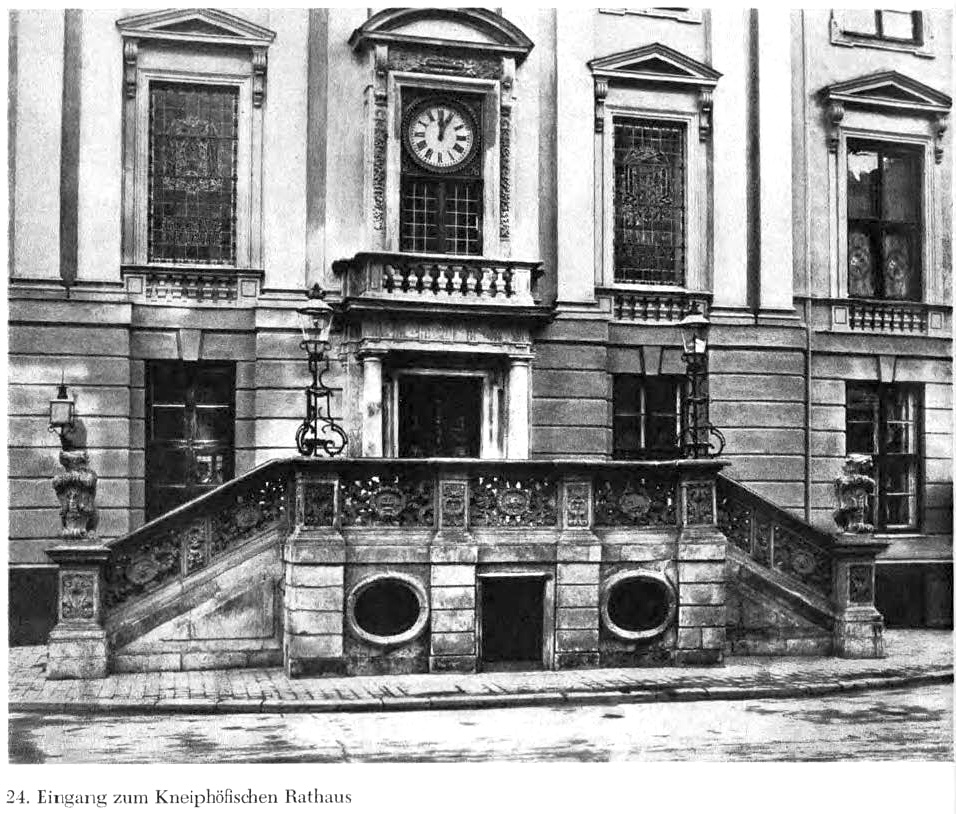
Entrance to the
City Museum
The original town hall on Kneiphof, situated on the west end of that small island, with the cathedral on the east end, served as the townhall for the whole of Königsberg when Kneiphof, Altstadt, and Löbenicht were incorporated in 1724. A new town hall was built in 1927 (on the Hansaring in the northwest quarter of the city), which allowed the Kneiphof Rathaus to be re-purposed as a twenty-five room Stadtgeschichtliche Museum. The ground floor was given over to a “Kant-Museum” with Room #8 designated as the “Kant-Zimmer,” and additional Kantiana on display in rooms 3, 6, 7, and 20. The two directors of this museum, during its brief existence, were Eduard Anderson (1 Oct 1927-1938) and Fritz Gause (1938-1945) [Gause 1996, 3: 86-87; Schmidtke 1997, 262, 298].
1923-28: Kant Room (Albertina)
)
)
Kant-Zimmer
Albertinum
)
)
)
1928-44: Kant Room (Stadtgeschichtliche Museum)
)
Kant-Zimmer
Kneiphof Rathaus
 "Postcard property of the Ostpreussische Landesmuseum Lüneburg(?); image found on Andreas Vieth's webpage")
Kant-Zimmer
Kneiphof Rathaus
)
Kant-Zimmer
Kneiphof Rathaus
)
Kant-Zimmer
Kneiphof Rathaus
)
Kant-Zimmer
Kneiphof Rathaus
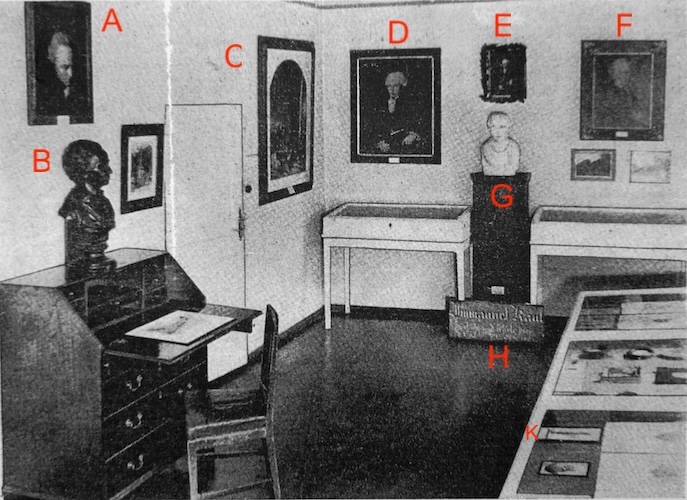
Kant-Zimmer (Albertina) – Annotated
A = Dresden; B = Mattersberger bust; C = Exhumation drawing; D = anon. portrait; E = Petzenburg copy of Döbler; F = Becker(b); G = Siemering bust; I = Keyserling chalk portrait; K = Puttrich silhouette
Kant-Zimmer (Stadtgeschichtliche Museum) – Annotated
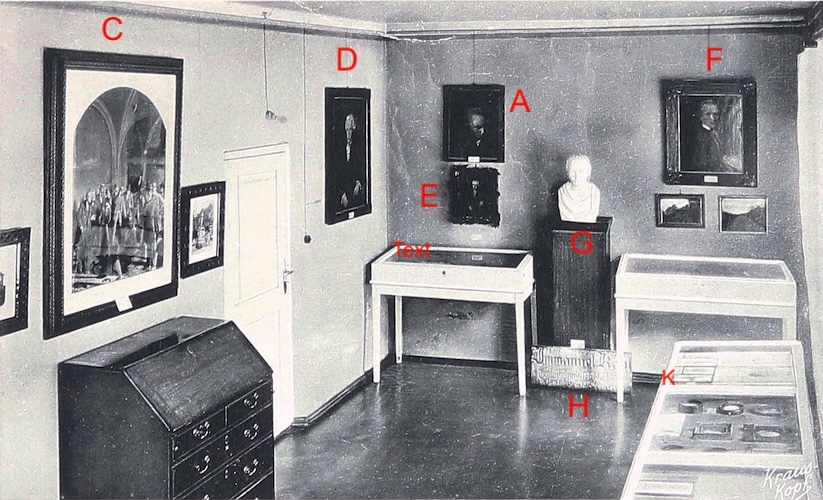
A = Dresden; B = Mattersberger bust; C = Exhumation drawing; D = anon. portrait; E = Petzenburg copy of Döbler; F = Becker(b); G = Siemering bust; H = Plaque on Kant’s House; I = Keyserling chalk portrait; K = Puttrich silhouette
Descriptions of the above from Eduard Anderson’s catalog of the Kantiana collection kept in several rooms of the City Historical Museum [1936]:
A – Room 8: East wall (top), South wall (bottom)
Portrait, bust portrait, unknown master. So-called “painting from the Dresden art trade.” In 1896, a Dresden art dealer purchased this portrait. Its artist is likely to be associated with Anton Graff. The year of creation is presumed to be 1790. Oil on canvas. 40 x 53 cm. H. / Owner: The Museum.
Kantbildnis, Brustbild, unbekannter Meister. Sogenanntes „Gemälde aus dem Dresdner Kunsthandel". Im Jahre 1896 kaufte dieses Bildnis eine Dresdener Kunsthandlung. Sein Schöpfer wird in der Nähe von Anton Graff zu finden sein. Als Entstehungsjahr ist 1790 anzunehmen. Ölgemälde auf Leinwand. 40 x 53 cm. H. / Besitzer: Das Museum.
B – Room 8: East wall
Plaster bust of Kant by Mattersberger, tinted black. Thought to have come from Kant’s estate, and Clasen thought it was probably modeled from life. Some casts of the bust are dated 1795. / Owner: The Museum.
Gipsbüste Kants von Mattersberger, schwarz getönt. Nach der Überlieferung aus dem Nachlaß Kants. Nach Clasen wahrscheinlich nach dem Leben modelliert. Einige Büstenabgüsse sind mit dem Jahr 1795 datiert. / Besitzer: Das Museum. [Anderson 1936, 16]
C – Room 8: East wall
The opening of Kant’s grave in 1880. Chalk drawing by Johannes Heydeck. Kant was buried on February 28, 1804, in the so-called “Professors’ Crypt” on the north side of the cathedral choir. In 1809, his friend Scheffner placed a stone on his grave bearing the inscription: Sepulcrum Immanuel Kant / Born on the 10th day before the Ides of May, MDCCXXIV / Died on the day before the Ides of February, MDCCCIV / This monument was erected by his friend Scheffner, MDCCCIX. (Dates according to the Roman calendar).
When the colonnade known as the “Stoa Kantiana,” which extended along the north wall of the cathedral choir, was demolished due to its dilapidation, a Neo-Gothic chapel was erected on the site where Scheffner’s stone had stood – a space that had been enclosed by a grille—based on a design by architect Parmann. Inside, on the east wall, stood a marble bust of Kant (now in the museum). Behind it, on the wall, was a black-and-white copy by Emil Neide of Raphael’s “School of Athens” (now in the city’s art collections). Kant’s grave was opened at that time – that is, from June 18 to June 22, 1880, and the days that followed. The painter Johannes Heydeck, a professor at the Academy of Fine Arts conducted the excavation, having had extensive experience in such work due to his prehistoric archaeological research, and his meticulous work methodology successfully located Kant’s remains in the ground. He then captured the event, including the witnesses to the excavation, in this lifelike image, depicting the figures in a portrait-like manner. Professor Heydeck stands in the grave, handing the skull to the Kant scholar [Emil] Arnold. The other gentlemen, from left to right, are: Master Builder Hüter, Prof. Witt, and Prof. Walter, who succeeded Kant in his chair in 1880. Standing bent over in front of them are Prof. L. Rosenfelder, retired director of the Academy of Fine Arts, and August Wittich, city librarian. Standing in front of him are Prof. Kupfer, an anatomist; then Dr. Reicke, a Kant scholar; and City Treasurer Hoffmann. In the foreground, holding the lower jaw in his hand, is Prof. Albrecht, the prosector; next to him is medical student F. Bessel-Hagen; behind him is the sculptor Eckhardt. / Owner: Prussia Museum.
Die Öffnung des Kantgrabes 1880. Kreidezeichnung von Johannes Heydeck. Kant wurde am 28. Februar 1804 im sogenannten Professorengewölbe an der Nordseite des Domchors beerdigt. Sein Freund Scheffner setzte ihm 1809 einen Stein auf sein Grab mit der Inschrift: Sepulcrum Immanuel Kant / Nati a. d. X Calend. Maji a MDCCXXIV / Denati pridie Id. Februar a MDCCCIV / Hoc monumento signavit amicus Scheffner MDCCCIX. (Datum nach dem römischen Kalender).
Als der „Stoa Kantiana" benannte Wandelgang längs der nördlichen Domchormauer infolge Baufälligkeit abgebrochen wurde, errichtete man über der Stelle, wo der Stein Scheffners lag, die durch ein Gitter abgeschlossen wurde, nach dem Entwurf des Baumeisters Parmann eine in neugotischen Formen gehaltene Kapelle. Darin stand an der Ostwand die Marmorbüste Kants (jetzt im Museum). Dahinter an der Wand befand sich eine von Emil Neide schwarz-weiß gemalte Kopie der “Schule von Athen” von Rafael (jetzt in den Kunstsammlungen der Stadt). Damals, also 1880-22. Juni und den nachfolgenden Tagen –, wurde das Grab Kants geöffnet. Der Maler Johannes Heydeck, Professor an der Kunstakademie, der durch seine vorgeschichtlichen Bodenforschungen große Erfahrung in solchen Arbeiten hatte, nahm die Ausgrabung vor. Seine sorgfältige Arbeitsmethode hat die Gebeine Kants einwandfrei in der Erde ermittelt. Den Vorgang, einschließlich der Zeugen der Grabung, hat er in diesem lebenswahren Bilde - die Personen porträtähnlich - festgehalten. Professor Heydeck steht in der Grube; er reicht dem Kantforscher Arnold den Schädel zu. Die andern Herren sind von links nach rechts: Baumeister Hüter, Prof. Witt, Prof. Walter, 1880 auf Kants Lehrstuhl. Gebückt davor stehend Prof. L. Rosenfelder, Direktor der Kunstakademie i. R., August Wittich, Stadtbibliothekar. Vor ihm stehend Prof. Kupfer, Anatom, dann Dr. Reicke, Kantforscher, Stadtkämmerer Hoffmann. Im Vordergrund, den Unterkiefer in der Hand haltend, Prof. Albrecht, Prosektor, daneben cand. med. F. Bessel-Hagen, hinter ihm der Bildhauer Eckhardt. / Besitzer: Prussia-Museum.
D – Room 8: South wall (top), East wall (bottom)
Portrait in profile, three-quarter length, by an unknown master. Strongly reminiscent of Doebler, though with duller colors and lacking true three-dimensionality. Oil on canvas, 67 x 83 cm. H. / Owner: The Museum.
Kantbildnis, Kniestück, unbekannter Meister. Starke Anlehnung an Doebler, jedoch matter in den Farben und ohne rechte Plastik. Ölgemälde auf Leinwand, 67 x 83 cm. H. / Besitzer: Das Museum.
E – Room 8: South wall
Portrait of Kant, three-quarter length, 1791. Copy by Petzenburg, after the original by Doebler. Doebler, a student of Edmund Francis Cuningham, donated the original painting – which he created in Königsberg – to the “Skull and Phoenix” Masonic Lodge. This painting was widely regarded as one of the finest portraits of Kant. Oil on canvas. 28.5 x 35 cm. H. / Owner: The Museum.
Kantbildnis, Kniestück, 1791. Kopie von Petzenburg, nach dem Original von Doebler. Dieser, ein Schüler von Edmund Francis Cuningham, schenkte das von ihm in Königsberg geschaffene Originalgemälde der Loge zum Totenkopf und Phönix. Dies Gemälde wurde allgemein als eines der besten Bildnisse Kants bezeichnet. Ölgemälde auf Leinwand. 28,5 x 35 cm. H. / Besitzer: Das Museum.
F – Room 8: South wall
Portrait of Kant as a young man, a bust portrait by Becker. As indicated in a letter from Hamann to Herder, it was painted in 1768. There are three portraits by Becker: a pastel study (A) and two oil paintings (B and C). Kant’s brother received the pastel portrait in Courland, an oil portrait went to the Kanter bookstore (C), and the third portrait (B) remained in Kant’s possession. This portrait was acquired at the estate auction by innkeeper Meyer, who purchased Kant’s house, and subsequently came into the possession of the rentier Kinze in Dresden. It was repurchased from him for the Kant Room. Oil on canvas, 45 x 69 cm. H. / Owner: The Museum.
Jugendbild Kants, Brustbild, von Becker. Wie aus einem Brief Hamanns an Herder hervorgeht, 1768 gemalt. Von Becker gibt es drei Bilder: Eine Pastellstudie und zwei Ölgemälde. Das Pastellbild erhielt der Bruder Kants in Kurland, ein Ölporträt der Buchladen von Kanter und das dritte Bild verblieb in Kants Besitz. Dieses Bild wurde auf der Nachlaßversteigerung vom Gastwirt Meyer, der Kants Haus kaufte, erworben und gelangte in den Besitz des Rentiers Kinze in Dresden. Von ihm ist es für das Kantzimmer zurückgekauft worden. Ölgemälde auf Leinwand, 45 x 69 cm. H. / Besitzer: Das Museum.
G – Room 8: South wall
Marble bust of Kant by Rudolf Siemering. Based on the original by Hagemann from 1801, located in the University Senate Room. / Owner: The Museum.
Marmorbüste Kants von Rudolf Siemering. Nach dem Original von Hagemann aus dem Jahre 1801 im Senatszimmer der Universität. / Besitzer: Das Museum. [Anderson 1936, 15-16]
H – Room 8: South wall
Marble plaque. This marble plaque, featuring gilded, carved letters, was located on Kant’s residence, which was demolished in 1893. The inscription reads: “Immanuel Kant lived and taught here from 1783 to February 12, 1804.” On the back of the plaque is the inscription: “Emanuel Kant lived and taught here.” / Owner: Prussia Museum.
Marmortafel. An dem 1893 abgebrochenen Wohnhause Kants befand sich diese Marmortafel mit vergoldeten, eingemeißelten Buchstaben. Die Inschrift lautet: “Immanuel Kant wohnte und lehrte hier von 1783 bis 12. Februar 1804”. Auf der Rückseite der Platte die Fassung: “Emanuel Kant wohnte und lehrte hier”. / Besitzer: Prussia-Museum. [Anderson 1936, 16]
I – Room ?: ?? wall
Profile portrait, bust portrait: “The Young Kant,” chalk drawing by Countess Keyserling (copy), 24 x 34 cm. H. / Owner: Prussia Museum.
Kantbildnis, Brustbild: ,,Der junge Kant", Kreidezeichnung der Gräfin Keyserling (Kopie), 24 x 34 cm. H. / Besitzer: Prussia-Museum.
J – Room 8: East wall
Writing desk. Acquired following an authentication at the Kant estate auction. Polished brown wood (walnut), very finely crafted. / Owner: Prussia Museum.
Schreibkommode. Nach einer Beurkundung in der Kommode auf der Nachlaßauktion Kants erworben. Braun poliertes Holz (Nußbaum), sehr sauber gearbeitet. / Besitzer: Prussia-Museum. [Anderson 1936, 16]
K – Room 8
[Three versions of the Puttrich silhouette are catalogued by Anderson; those seen in these photos, might be any of the three.]
(1) (Room 8, vitrine 28):
Portrait of Immanuel Kant (standing). Etched after Puttrich’s silhouette in the aquatint style. Inscription: “Kant, born April 22, 1724, died February 12, 1804.” Handwritten note: “Donated by Count Gräfe Sr. of Prussia in 1862.” / Owner: Prussia Museum.
Bildnis Immanuel Kant (stehend). Nach der Silhouette von Puttrich in Aquatintamanier radiert. Unterschrift: Kant geb. d. 22. 4. 1724, gest. d. 12. 2. 1804.” Handschriftlich: “Von Herrn Gräfe sen. der Prussia geschenkt 1862.” / Besitzer: Prussia-Museum. [Anderson 1936, 10]
(2) (Room 8, vitrine 30):
Portrait of Immanuel Kant. Silhouette in black ink by Puttrich, Kant in full-length, standing, holding a cane and a hat. / Owner: Prussia Museum.
Bildnis Immanuel Kant. Silhouette in schwarzer Tusche von Puttrich, Kant in ganzer Figur, stehend, mit Stock und Hut in der Hand. / Besitzer: Prussia-Museum. [Anderson 1936, 13]
(3) (Room 8?):
A full-length portrait of Kant, standing. A copy by Harwardt, executed in ink after Puttrich’s silhouette. / Owner: City Library.
Kant in ganzer Figur, stehend. Nach der Silhouette von Puttrich in Tusche ausgeführte Kopie von Harwardt. / Besitzer: Stadtbibliothek. [Anderson 1936, 20]
#
Kant’s Death Mask: After Kant’s death, the painter Prof. Andreas Knorre made a plaster cast of his head. Three additional casts were made from this original. The museum’s cast was produced in 1924 by the mold maker Gräbe based on one of these casts. / Owner: The museum.
Totenmaske Kants, Der Maler Prof. Andreas Knorre hat nach dem Tode Kants dessen Kopf in Gips abgeformt. Davon wurden drei weitere Abgüsse angefertigt. Der Abguß des Museums ist nach einem dieser Abgüsse 1924 durch den Former Gräbe hergestellt worden. / Besitzer: Das Museum.
#
Kant’s Skull. On June 22 and the following days in 1880, Kant’s grave was opened (see the chalk drawing by Prof. Joh. Heydeck), and on that occasion, plasterer Meyke made a plaster cast of his skull. / Owner: The Museum.
Kants Schädel. Am 22. Juni und den folgenden Tagen 1880 wurde das Grab Kants geöffnet (siehe die Kreidezeichnung von Prof. Joh. Heydeck) und sein Schädel bei der Gelegenheit durch Stukkateur Meyke in Gips abgeformt. / Besitzer: Das Museum.
#
Profile portrait, bust portrait: “The Young Kant,” chalk drawing by Countess Keyserling (copy), 24 x 34 cm. H. / Owner: Prussia Museum.
Kantbildnis, Brustbild: “Der junge Kant", Kreidezeichnung der Gräfin Keyserling (Kopie), 24 x 34 cm. H. / Besitzer: Prussia-Museum.