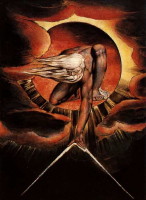
Place of Origin
Unclear. Possibly not a foreigner, but included here just in case.
Life Dates:
Uncertain.
Quote:
“Let there be light.” [Genesis 1:3]
Brief Note
While the general attributes of God are still much debated, as is indeed God’s very existence, suffice it to say that at least the idea of God, if not God in person(s), has exerted considerable influence on the thought and actions of many generations of Manchester students.
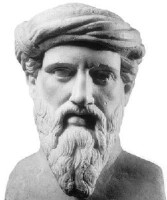
Place of Origin
Samos (a Greek island off the coast of present-day Turkey).
Life Dates
c.581-500 B.C.
Quote
“Let not a swallow nest under your roof.” [Kirk and Raven, #275]
Brief Note
Pythagoras founded a mystical brotherhood in Croton (Southern Italy) which believed that all reality was based on numbers. They studied the mathematical relationships of musical tones, and came up with the Pythagorean theorem (the sum of the squares of the two legs of a triangle equal the square of the hypotenuse). The Pythagoreans also sought to purify their souls by, among other things, eating neither meat nor beans.
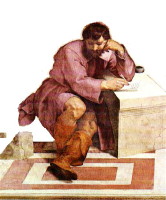
Place of Origin
Ephesus .
Life Dates
c.544-c.480 B.C.E.
Quote
“παντα χϖρει, ουδεν μενει.” (“Everything flows and nothing stays.”) [as quoted in Plato, Cratylus, 402a].
Brief Note
Heraclitus emphasized the transient nature of reality (“you can’t step into the same river twice”). This led others to infer that, for any particular kind of stuff, you can’t step into it more than once; but anyone who keeps dogs in their yard knows this to be false.
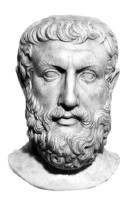
Place of Origin
Elea (a Greek colony on the southern Italian peninsula).
Life Dates
c.515-450 BCE.
Quote
“What can be thought is only the thought that it is.” [Kirk and Raven, #352]
Brief Note
This Pre-Socratic was in many ways the first logician, being more interested in logical features of reality than in mere appearance. He was the antithesis of Heraclitus in that he claimed reality to be absolutely unchanging, and that all change was therefore wholly unreal and illusory. Parmenides had no story to tell of how the universe evolved, for the real never changes, and what interested him was the real. Indeed, he was more interested in the logical nature of reality than in using this reality as a means to explain appearances (what could be called ‘nature’, and which consequently was neglected by the Eleatics). “What is not”, for Parmenides, is unthinkable; there is nothing about “nothingness” that we can grasp hold of with our minds, and so it is unthinkable. His student, Zeno of Elea, formulated a set of paradoxes which attempt to show the self-contradictory nature of motion and change.
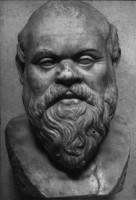
Place of Origin
Athens.
Life Dates
469-399 BCE.
Quote
“The unexamined life is not worth living.” [Plato, Apology, 38a]
Brief Note
Socrates examined the lives of his fellow Athenians a bit too closely, and for that was condemned to death (by drinking hemlock). He discovered that he was the wisest of all human beings insofar as he at knew of his own ignorance, whereas most people believed they had knowledge when in fact they had none. This “midwife of the mind” was among the first western philosophers to study closely the nature of the good and the just.
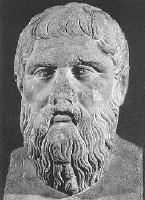
Place of Origin
Athens
Life Dates
427-347 BCE.
Quote
“We must examine this more carefully, for what we are discussing is no small matter, but the manner in which we ought to conduct our lives.” [Republic, Bk. 1, 352d]
Brief Note
The most gifted of Socrates’s disciples, Plato was not merely an excellent philosopher but also a master of Greek prose. Most of his philosophical works were written as dialogues, perhaps to be performed on the stage. Plato’s Academy, which he opened in 370 B.C., was the first “school” in the western sense. His influence has been profound and far-reaching, such that the history of philosophy has been said to be merely a set of footnotes to him

Place of Origin
Macedonia, but also spent time in Athens.
Life Dates
384-322 BCE.
Quote
“Plato is dear to me, but dearer still is truth.”
Brief Note
This guy knew pretty much all there was to know for his time, writing important works on many of the natural sciences as well as wide-ranging works in philosophy. The father of biology and an important metaphysician, logician, and ethicist, Aristotle was Plato’s brightest pupil (and cleverest opponent), and also happened to be the private tutor of Alexander the Great.
Like his teacher Plato, Aristotle also opened a school (the Lyceum) and his students and followers were called “peripatetics” (from the Greek ‘peripateo’ = to walk around) because he liked to lecture while walking around.
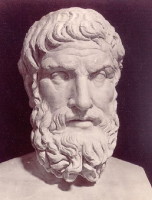
Place of Origin
Samos (a Greek island off the coast of present-day Turkey); moved to Athens.
Life Dates
342-275 BCE.
Quote
“Send me some preserved cheese that, when I like, I may have a feast.”
Brief Note
Epicurus (after which is named Epicureanism) established a philosophical community in Athens (in his “gardens”) in 307 B.C. Central for this community was the belief that the world consisted of atoms, from which it was concluded that pleasure was the ultimate goal of human life (intellectual pleasures being emphasized over bodily since they were more durable and less costly). They also believed that humans have no immortal soul, and that consequently death is not to be feared (“when you are alive, death is not; and when you are dead, you are not”).
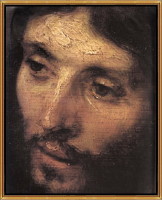
Place of Origin
Galilee.
Life Dates
c.4 BCE-29 CE.
Quote
“Where your treasure is, there will your heart be also.” [Matthew 6:21]
Brief Note
Jesus was a Jewish itinerant preacher who wore sandals, practiced pacifism, and became one of the more famous victims of state-sanctioned capital punishment. His life and thought has inspired generations of students at Manchester.
Place of Origin
Hierapolis (in the Greek state of Phrygia).
Life Dates
50-125 CE.
Quote
“Remember that you are an actor in a play, which is as the playwright wants it to be: short if he wants it short, long if he wants it long. If he wants you to play a beggar, play even this part skillfully, or a cripple, or a public official, or a private citizen. What is yours is to play the assigned part well. But to choose it belongs to someone else.” [Enchiridion, §17]
Brief Note
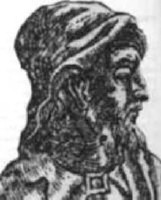
Epictetus was a Roman slave and a principal founder of Stoicism. The first goal of philosophy, according to Epictetus, is to distinguish that which is in our power from that which is not. Only the ideas in our head are within our power, but fortunately these alone are what determine our happiness. Thus the road to happiness is self-control.
Place of Origin
Rome.
Life Dates
121-180 CE.
Quote
“It is peculiar to man to love even those who do wrong. And this happens if, when they do wrong, it occurs to you that they are kinsmen, and that they do wrong through ignorance and unintentionally, and that soon both of you will die; and above all, that the wrong-doer has done you no harm, for he has not made your ruling faculty worse than it was before.” [Meditations]
Brief Note
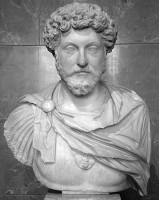
Here was a great Stoic philosopher who became a good Roman Emperor. Stoicism is marked by its emphasis on calmly accepting whatever disaster life presents, and to abide one’s place in the scheme of things.

Place of Origin
Hippo (North Africa).
Life Dates
345-430 CE.
Quote
“Da mihi castitatem et continentiam, sed noli modo.” (“Give me chastity and continency — but not yet!”) [Confessions, Bk. vii, ch. 7]
Brief Note
Although raised by a devoutly Christian mother (Saint Monica), early years spent in Carthage (“a hissing cauldron of lust”) soon robbed him of his Christian ideals and set him on a more worldly path. After a licentious puberty in the pursuit of “promotion, profit, and praise,” Augustine was led back to the Christian faith through a singular event under a tree.
He was later made a Bishop (against his will) during which time he wrote his Confessions and City of God — both of which are classics of early Christian and philosophical thought. His motto: “Credo ut intelligam” (“I believe so that I may understand”). Augustine died on the eve that the invading Vandals burnt Hippo.
Place of Origin
Alexandria (Egypt).
Life Dates
†415 CE.
Quote
“Fables should be taught as fables, myths as myths, and miracles as poetic fancies. To teach superstitions as truths is a terrible thing. The child mind accepts and believes them, and only through great pain and perhaps tragedy can he later be relieved of them. In fact, men will fight for a superstition quite as quickly as for a living truth — often more so, since a superstition is so intangible you cannot get at it to refute it, but truth is a point of view, and so is changeable.”
Brief Note
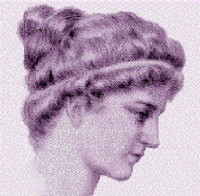
Little is known of this woman who belonged to the Neoplatonic school at Alexandria (Egypt), although recent scholarship indicates that she was about 60 years old when she was murdered. Hypatia was an important mathematician and the teacher of, among others, Bishop Synesius of Cyrene. In 415 she was murdered by a fanatical mob of Christians encouraged by Saint Cyril (whose hands were already bloody with the murder of Jews). Gibbon offers the following description: Hypatia was “torn from her chariot, stripped naked, dragged to the church, and inhumanly butchered by the hands of Peter the Reader and a troop of savage and merciless fanatics: her flesh was scraped from her bones with sharp oyster-shells and her quivering limbs were delivered to the flames.” This murder marked the end of philosophy in Alexandria. There are currently two journals of philosophy named in honor of her.
Place of Origin
Mecca (in the sands of Arabia).
Life Dates
570-632 CE.
Quote
“No person drinks better than when they swallow anger for God's sake.”
Brief Note
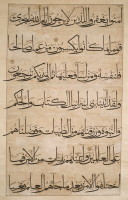
Muhammad was the Prophet of Islam, who hearkened to the good call at the age of forty. His teachings and revelations, as recorded in the Koran, form the basis of the Islam faith.
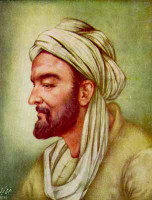
Place of Origin
Bukhara (Persia).
Life Dates
980-1037 CE.
Quote
“The knowledge of anything, since all things have causes, is not acquired or complete unless it is known by its causes.”
Brief Note
Avicenna (in Arabic: Ibn Sina, Abu’Ali al-Husayn) was a Muslim physician and one of the brightest mortals of his century, having mastered a number of subjects before the age of eighteen. After a good bit of travelling, Avicenna eventually settled in Teheran. He taught and practiced both medicine and philosophy, and while his philosophical opinions drew the hatred of the religiously orthodox, the princes would protect him because of his medical skills. He was an important commentator on Aristotle, and a profound and original philosopher in his own right.
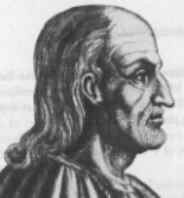
Place of Origin
Aosta (northwest Italy).
Life Dates
1033-1109 CE.
Quote
“I do not seek to understand that I may believe, but I believe in order to understand.”
Brief Note
Anselm preferred the life of the mind to that of the administrator, and had to be bodily dragged to the king in order to receive his commission as Archbishop of Canterbury. He is generally considered the Father of Scholasticism (the application of logic to matters of theology), and developed a proof of God’s existence based strictly on the meaning of the word ‘God’ (namely, that being than which none greater can be conceived).
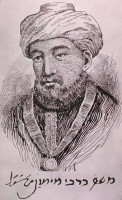
Place of Origin
Cordoba (Spain).
Life Dates
1135-1204 CE.
Quote
“Do not consider it proof just because it is written in books, for a liar who will deceive with his tongue will not hesitate to do the same with his pen.”
Brief Note
Maimonides is generally considered to be the greatest Jewish philosopher of the Middle Ages. “From Moses to Moses, there was none like Moses” — such is the high esteem he enjoys. His Guide for the Perplexed (1190, publ. in Arabic) argued that philosophical truth is consistent with scripture, so long as the latter is read allegorically.
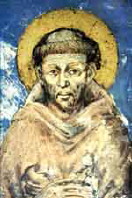
Place of Origin
Assisi (Italy).
Life Dates
c.1182-1226 CE.
Quote
“Let us take example from the beasts and birds, who, when they receive their food are content, and seek only what they need from hour to hour: and so also ought man to be content with what is barely sufficient temperately to supply his needs, asking no more.” [from The Little Flowers of St. Francis]
Brief Note
Born into wealth, St. Francis underwent a conversion experience at the age of twenty-two, just when many people leave college and join the ranks of the unemployed. He became increasingly ascetic and eventually founded the brown-robed order of Franciscan monks. St. Francis was known for his poverty, humility, and his deep love of nature. His feast day is October 4.

Place of Origin
Roccasecca (near Naples).
Life Dates
1225-1274 CE.
Quote
“There is a twofold mode of truth in what we profess about God. Some truths about God exceed all the ability of human reason. Such is the truth that God is triune. But there are some truths which natural reason also is able to reach. Such are that God exists, that He is one, and the like. In fact, such truths about God have been proved demonstratively by the philosophers, guided by the light of natural reason.” [Summa Contra Gentiles, vol. I, ch. 3, §2]
Brief Note
Born into nobility, Thomas met with heavy resistance from his family when he announced his desire to become “a simple friar.” At one point his six brothers kidnapped him and tried to seduce him with a beautiful naked woman sent into his chambers (legend has it that Thomas promptly chased her out with a firebrand from the hearth).
He eventually managed to join the black-robed Dominicans, and began his studies under Albert the Great. Thomas was nick-named “the dumb ox” because of his extreme obesity and apparent stupidity, but eventually rose to such prominence that he was later called to lecture at the University of Paris, and then at Rome.
His many writings include the voluminous Summa Contra Gentiles (a work aimed at converting non-Christians) and Summa Theologiae (a massive work of systematic theology), wherein he assimilated the dominant philosophy of the day (Aristotelianism) with Christian doctrine. Although Thomas’s views were controversial, and for a while condemned, they eventually became the intellectual foundation of the Roman Catholic Church.
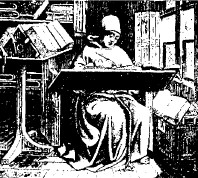
Place of Origin
Ockham (near London).
Life Dates
c.1285-1349 CE.
Quote
“What can be done with fewer assumptions is done in vain with more.”
Brief Note
Best known for his “razor,” which he used to trim away unnecessary principles and entities, Ockham was a Franciscan monk and the most capable logician of his day — an intellectual equal to Aquinas. It was Ockham who finally was able to disambiguate — much to the relief of the educated public — such sentences as: “Everybody loves somebody” and “Bill owes Mary a horse.”
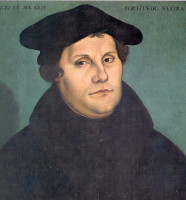
Place of Origin
Eisleben (in Saxony, Germany).
Life Dates
1483-1546 CE.
Quote
“Darum gibt unser Herr Gott gemeiniglich Reichtum den grossen Eseln, denen er sonst nichts gönnt” (“So our Lord God commonly gives riches to those big asses to whom He vouchsafes nothing else.”) [Colloquia, ch. 20]
Brief Note
This man who, when sinning, “sinned boldly” and “could not do otherwise,” re-read Romans 1:17 and picked-up his hammer and nail to affix his Ninety-Five Theses on Indulgences to the door of the Wittenburg castle church. Thus began the Protestant Reformation, the effects of which are still felt to this day.
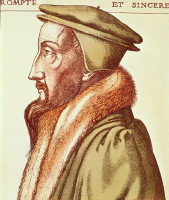
Place of Origin
Noyon (France).
Life Dates
1509-1564 CE.
Quote
“How difficult it is to perform the duty of seeking the good of our neighbor! Unless you leave off all thought of yourself, and in a manner cease to be yourself, you will never accomplish it.” [“The Life of a Christian Man” from Institutes of the Christian Religion]
Brief Note
After studying theology in Paris, by 1534 Calvin had broken with Catholicism and joined the Protestant reform movement in France. He spent the remainder of his life turning Geneva (Switzerland) into a theocratic state. The Reformed and Presbyterian churches look back to Calvin as their principle founder.
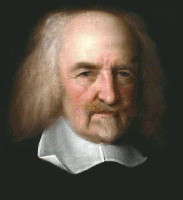
Place of Origin
Malmesbury (England).
Life Dates
1588-1679 CE.
Quote
“During the time men live without a common power to keep them all in awe, they are in that condition which is called WAR; and such a war as is of every man against every man … the nature of war consisteth not in actual fighting, but in the known disposition thereto during all the time there is no assurance to the contrary.” [Leviathan, ch. 13]
Brief Note
Hobbes was born prematurely when his mother heard of the approach of the Spanish Armada (“Fear and I were born twins”). He was a famous materialist and proponent of the “New Science” of Galileo and Descartes; thus he viewed human beings as mere composites of matter and our social interactions analogous to the rude bumping of clumps of matter in motion. Prior to the institution of a political state, human existence was in a “state of nature” wherein our lives were “solitary, poor, nasty, brutish, and short.”
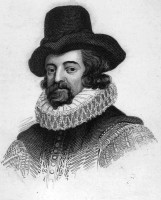
Place of Origin
Life Dates
1561-1626 CE.
Quote
“Scientia potestas est” (“Knowledge is power”) [De haeresibus, 1597]
Brief Note
Bacon excelled in philosophy and essays, as well as politics, where he rose to the position of lord chancellor (retiring in 1621 after having been convicted for taking bribes). Bacon made significant contributions to scientific methodology, emphasizing the importance of inductive reasoning and experimentation, in both his Novum Organum (1620) and his New Atlantis (1627). He died from the flu, as a result of his experiments concerning the preservation of chickens in snow.
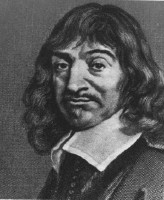
Place of Origin
Le Haye [later renamed ‘Descartes’] (France).
Life Dates
1596-1650 CE.
Quote
“Le bon sense est la chose du monde la mieux partagée, car chacun pense en etre bien pourvu.” (“Common sense is the best distributed commodity in the world, for every man is convinced that he is well supplied with it.”)
Brief Note
“Cogito ergo sum” (“I think therefore I am”) was the discovery that saved Descartes from thoroughgoing skepticism, and it became the foundation for all of his beliefs about the world. Descartes also made important advances in mathematics, having invented the “cartesian graph” (which allowed the joining of arithmetic and geometry). Acclaimed throughout Europe for his “New Philosophy,” he was invited by Queen Christina of Sweden to be her private tutor. Tutoring the Queen in philosophy proved Descartes’s undoing, however, as the only time she had available for her studies was at 5 a.m., and Descartes had been accustomed all his life of sleeping until noon. After a brief stint of such torture, poor Descartes contracted pneumonia and died.
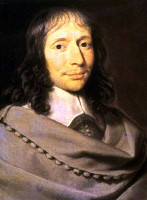
Place of Origin
Clermont-Ferrand (France).
Life Dates
1623-62 CE.
Quote
“It is not in space that I must seek my human dignity, but in the ordering of my thought. It will do me no good to own land. Through space the universe grasps me and swallows me up like a speck; through thought, I grasp it.” (Pensées, #113)
Brief Note
Pascal was a French scientist and mathematician. His mother died when he was three, and he was raised and educated by his father. As a child, he re-discovered the Pythagorean theorem, and in later life did important work in probability theory and physics — such as his development of an experiment corroborating Torricelli’s theory of barometric pressure (namely, that the earth is surrounded by “a sea of air”). Pascal was also a member of the French intellectual fast crowd, idling at gambling casinos and living the life of the dandy. But at the age of 31, during the night of November 23rd, 1654, he suffered a life-shaking conversion experience; and in the course of that night Pascal the gambling socialite turned into Pascal the religious ascetic. He is perhaps best known for his “Wager”: We cannot know whether God is or is not, but we do know this: if he is and we believe in him, then we win eternal happiness; if he is and we don’t believe, then we lose that and instead receive eternal damnation. On the other hand, if God is not, then we still win slightly with our belief in him, since it will make us better people. Convinced?
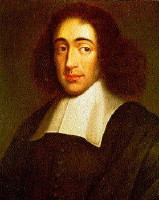
Place of Origin
Amsterdam (Holland).
Life Dates
1632-1677 CE.
Quote
“Sedula curavi, humanas actiones non ridere, non lugere, neque detestare, sed intelligare.” (“I have striven not to laugh at human actions, not to weep at them, nor to hate them, but to understand them.”) [Tractatus Politicus, 1, iv]
Brief Note
Spinoza devoutly believed that God was an absolutely infinite being, and thus was commensurate with the physical world (“deus sive nature”; “God or nature”). For this he was branded an atheist and was condemned by Jews and Christians alike. (Those who knew him rather thought of him as a saint.) He supported himself as a lens-grinder, living in a small room above a Mennonite family.
His most famous work, Ethics, was an attempt to derive metaphysical and moral truths from a small set of self-evident axioms, much as Euclid had done with geometry. Many of Europe’s leading intellectuals visited Spinoza in his little attic room, but his name was always surrounded by controversy. He died prematurely, as a result of having breathed too much glass dust. Spinoza’s fame and influence continued to grow after his death, and his thought was an important thread of the “Enlightenment”: we find, for instance, that Lessing was a deep admirer of Spinoza, and that the acclaimed Goethe always kept his copy of Spinoza’s Ethics in his coat pocket.
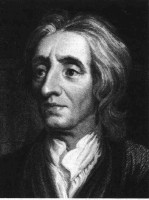
Place of Origin
Wrington (England).
Life Dates
1632-1704 CE.
Quote
“New opinions are always suspected, and usually opposed, without any other reason but because they are not already common.” [from the dedicatory epistle to An Essay Concerning Human Understanding]
Brief Note
Locke was trained in medicine as well as in philosophy, and the former training eventually found him a job as a private physician to Lord Shaftesbury, one of the movers and shakers of English politics. Life in the fast lane required Locke to flee to Holland for a few years and live under an assumed name when his patron was charged by the Crown with treason. Locke later returned to England in the entourage of William and Mary, who were installed as the new King and Queen of England after the “Glorious Revolution” of 1688.
Such dabbling in politics led Locke to musing on political philosophy, and in his Second Treatise on Civil Government we find a foundation stone of the U. S. Constitution (which was written a century later). Locke also spent some twenty years developing his thoughts on the nature of mind, culminating in the publication of his Essay Concerning Human Understanding, for which efforts he has been widely regarded as the founder of the “British Empiricists”.
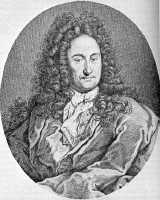
Place of Origin
Leipzig (Germany).
Life Dates
1646-1716 CE.
Quote
“Every individual substance expresses the whole universe in its own manner and in its full concept is included all its experiences.” [Discourse on Metaphysics, ix]
Brief Note
This is the “best of all possible worlds,” according to Leibniz (a perfect God would create the best world that he could within the constraints of logic; there is a perfect God; therefore…). Like Locke in England, Leibniz had his hands in politics as well as philosophy; but unlike Locke, Leibniz was truly a genius, a modern-day Aristotle who seemed to know all there was to know, and even a little bit more. He did important work in mathematics (discovering the calculus), logic, metaphysics, philosophical theology, and was a wide-ranging correspondent.
In metaphysics, Leibniz is best known for introducing the concept of the “monad” (or “individual substance”), an infinitely small immaterial atom out of which everything is made (including rocks, human beings, cows, etc.). The human soul is a single monad (therefore simple, therefore indestructible, therefore immortal). Generations of undergraduates have scoffed at Leibniz’s monadology as utter foolishness, but a modern physicist might view his idea as being generally on the right track.
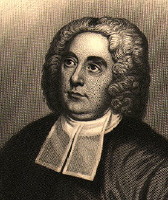
Place of Origin
Dysert (Ireland).
Life Dates
1685-1754 CE.
Quote
“All the choir of heaven and furniture of earth — in a word, all those bodies which compose the mighty frame of the world — have not any subsistence without a mind.” [Principles of Human Knowledge]
Brief Note
Berkeley worked out his most important ideas in philosophy before his was thirty. He was an active social reformer (eventually being made an Anglican Bishop of a poor province of Ireland), and among other projects attempted to found a university in the New World (in Bermuda) where the indigenous people could receive an education, as well as the children of the European colonists.
He was also a staunch opponent of the “New Science,” the materialism of Newtonian mechanics, and for this he won few friends. Berkeley’s memorable slogan was “esse est percipi” (“to be is to be perceived”) which amounts to a rejection of the existence of matter (the stuff that supposedly moved in accordance with Newton’s three laws of motion). The physical world is a construction of sensations, delivered into our minds by God. (If this sounds crazy, just go talk to a quantum physicist!)
Berkeley believed that civilization was slowly moving westward, and that his Europe was in decay, leading him to pen the line “Westward the course of empire takes its way”; as a result of this sentiment, a city on the coast of California was later named after him.
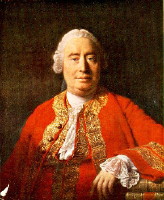
Place of Origin
Edinburgh (Scotland).
Life Dates
1711-1776 CE.
Quote
“If we take in our hand any volume of divinity or school metaphysics, for instance, let us ask, Does it contain any abstract reasoning concerning quantity or number? No. Does it contain any experimental reasoning, concerning matter of fact and existence? No. Commit it then to the flames, for it can contain nothing but sophistry and illusion.” [An Enquiry Concerning Human Understanding, sec. 12, pt. iii]
Brief Note
Hume was a beloved socialite and a wizard at backgammon. Too controversial for any academic positions, he worked for a while as a librarian in his native Edinburgh (during which time he wrote his famous history of England).
In philosophy, Hume was a thoroughgoing skeptic, and an atheist all the way to the grave. He wrote important works on ethics, the nature of the mind and knowledge, and religion. His famous Dialogues on Natural Religion were published only after his death, since he feared the scandal that they would (and did) arouse.
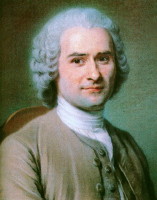
Place of Origin
Geneva (Switzerland).
Life Dates
1712-1778 CE.
Quote
“L’homme est né libre, et partout il est dans les fers.” (“Man was born free, and everywhere he is in chains.”) [The Social Contract, ch. 1]
Brief Note
Fabulously famous during his time, Rousseau’s literary works on education and culture were read throughout Europe. His fame began with an early essay, the prize-winning Discourse on the Sciences and the Arts (1750), wherein he argued that civilization has in general been harmful to human well-being. In the Discourse on Inequality (1755), Rousseau argued that private property has led to various social disorders, and in 1761 he published what was to become the most widely-read novel of the century: The New Heloise, a story of love and virtue. In 1762 he published his politically important work on The Social Contract, as well as his novel Émile. Rousseau became the patron saint of Romanticism (an intellectual movement that would sweep Europe in the early 1800’s).
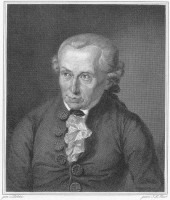
Place of Origin
Königsberg (Germany).
Life Dates
1724-1804 CE.
Quote
“Zwei Dinge erfüllen das Gemüt mit immer neuer und zuhehmenden Bewunderung und Ehrfurcht, je öfter und anhaltender sich das Nachdenken damit beschäftigt: Der bestirnte Himmel über mir, und das moralische Gesetz in mir.” (“Two things fill the mind with ever new and increasing wonder and awe, the more often and the more seriously reflection concentrates upon them: the starry heaven above me and the moral law within me.”) [“Conclusion” to the Critique of Practical Reason]
Brief Note
Kant was the first important philosopher who also taught philosophy in a university. And after Plato, Aristotle, and maybe Descartes, he has done the most to alter the way that philosophers pursue their discipline. He was “awakened from his dogmatic slumbers” rather late in life by reading David Hume, and went on to write one of the greatest (and most difficult) books in the history of philosophy: The Critique of Pure Reason (1781). While at first widely misunderstood, this book went on to change the way that we think of ourselves and the physical universe.
Tradition has it that Kant’s life ran like a Swiss clock, with all the regularity and order of a man who embodied reason itself — although if this was true of Kant at all, it was true only of his later years. One legend is that the neighbor women would set their clocks by his afternoon walks, which he began promptly at 3:30 (the path that he took came to be called “The Philosopher’s Walk”), and that Kant failed in this routine only once: when Rousseau’s new book Emile had arrived, and Kant was unable to put it down.
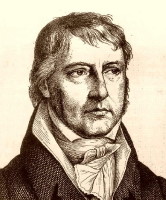
Place of Origin
Stuttgart (Germany).
Life Dates
1770-1831 CE.
Quote
“The true shape in which truth exists can only be the scientific system of such truth. To help bring philosophy closer to the form of Science, to the goal where it can lay aside the title ‘love of knowing’ and be actual knowing — that is what I have set myself to do.” [from the “Preface” to Phenomenology of Mind]
Brief Note
Hegel was an idealist in the sense that he viewed the history of the world as the history of the development of mind becoming aware of itself (passing through various stages of thesis, antithesis, and synthesis). Like Kant, Hegel was also a university professor, teaching first at Jena (he was finishing his famous Phenomology of Mind in 1806 while Napolean’s troops were invading the city) and then in Berlin until his death. Hegel was a greater literary stylist than Kant, but a much worse lecturer. While Kant would often move his students to tears of awe and inspiration, Hegel was giving to mumbling inaudibly into his lecture notes.
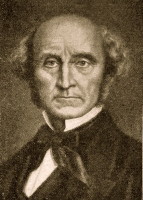
Place of Origin
London (England).
Life Dates
1806-1873 CE.
Quote
“If all mankind minus one were of one opinion, and only one person were of the contrary opinion, mankind would be no more justified in silencing that one person, than he, if he had the power, would be justified in silencing mankind.” [On Liberty, ch. 2]
Brief Note
Mill was a famous social reformer and utilitarian, holding to the belief that an action is morally correct if it maximizes overall happiness. He was a precocious scholar, as one learns from reading his Autobiography; for instance, he was reading Latin by the age of three, Greek by the age of eight, etc. Apart from his series of articles on utilitarianism, which forms a classic in moral philosophy, his work On Liberty is an important argument for the preservation and honor of individual liberties and the freedom of expression.
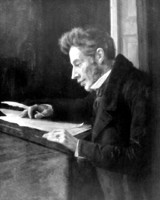
Place of Origin
Copenhagen (Denmark).
Life Dates
1813-1855 CE.
Quote
“People demand freedom of speech to make up for the freedom of thought which they avoid.”
Brief Note
Ridiculing Hegel was a favorite pastime of Kierkegaard’s. He was an unusual character, publishing articles and pamphlets under a number of different pseudonyms, often engaging in public debate with himself under the guise of two separate names. Many of his writings are considered religious classics, and he can be counted as a founding theoretician of 20th century existentialism. Kierkegaard is most popularly known for his belief in the need for “a leap of faith” in matters of religion.
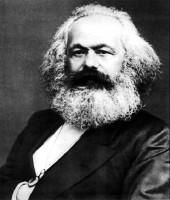
Place of Origin
Trier (Germany).
Life Dates
1818-1883 CE.
Quote
“The philosophers have only interpreted the world in various ways; the point is to change it.” [Theses on Feuerbach, xi]
Brief Note
A journalist by profession, Marx was steeped in Hegelian philosophy and had a natural bent towards social reform. He was highly critical of the social forms that a capitalist society assumes, and wrote of a day when there would arise a way of life more suitable to human beings.
He believed that our culture (religion, ethics, political system, etc.) is determined by the material features of our existence (this is what was involved in Marx “turning Hegel on his head”).
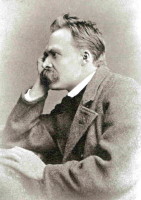
Place of Origin
Röcken (Germany).
Life Dates
1844-1900 CE.
Quote
“Wie ich den Philosophen verstehe, als einen furchtbaren Explosionsstoff, vor dem Alles in Gefahr ist.” (“What I understand by ‘philosopher’: a terrible explosive in the presence of which everything is in danger.”) [Ecce Homo, “Die Unzeitgemässen”]
Brief Note
Poor Nietzsche (pronounced: Knee-chuh) was a man ahead of his time, or at least this is how he viewed himself. He wrote of those rare individuals (“Übermenschen”, “Superhumans”) that are able to rise above the dross and mediocrity of their societies and develop their own beliefs about right and wrong. Nietzsche was trained as a philologist, and taught for a time at Basel (he had been awarded a professorship at the incredibly young age of 24). But his most lasting contribution has been as a social critic.
He fell permanently insane (from syphilis, it is believed) when he was only 46, and lived for his last ten years under the rule of his crazy sister and her rabidly anti-semitic husband. It was because of this last period that the Nazis later appropriated Nietzsche as an intellectual defender of Nazism. (Of course, anyone who reads Nietzsche quickly learns how deeply he despised the anti-semites, as well as the notion of the “German people” as something good.)
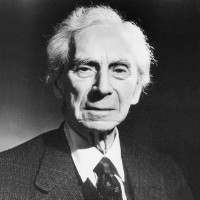
Place of Origin
Chepstow (England).
Life Dates
1872-1970 CE.
Quote
“The point of philosophy is to start with something so simple as not to seem worth stating, and to end with something so paradoxical that no one will believe it.” [“Lecture Two” of The Philosophy of Logical Atomism]
Brief Note
Russell was born into a line of progressive British politicians, and so from an early age felt that he, too, must be engaged in the betterment of society. Thus, far from being an ivory tower intellectual, Russell followed much in the steps of John Stuart Mill (who was his godfather) in working for social reform.
Russell’s most important philosophical work was in the philosophy of logic and mathematics, and he also published many popular works on the philosophy of education, love, sex, and morality. He was a devoted pacifist, and spent two stints in jail: once for six months in 1918 during the first world war for criticizing the United States (during which time he wrote his Introduction to Mathematical Philosophy), and once for a week in 1961 (at the age of 89) for protesting the production of nuclear weapons. Russell was awarded the Nobel Prize for Literature in 1950.
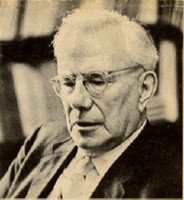
Place of Origin
Starzeddel (Germany).
Life Dates
1886-1965 CE.
Quote
“Being religious means asking passionately the question of the meaning of our existence and being willing to receive answers, even if the answers hurt.”
Brief Note
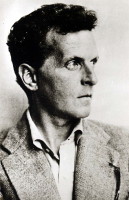
Place of Origin
Vienna (Austria).
Life Dates
1889-1951 CE.
Quote
“Die Welt ist alles, was der Fall ist. […] Wovon man nich sprechen kann, darüber muss man schweigen.” (“The world is everything that is the case. […] Of what one cannot speak, one must remain silent.”) [the first and last propositions of the Tractatus Logico-Philosophicus]
Brief Note
Wittgenstein was a troubled genius. Musically and mechanically gifted, he invented a sewing machine as a child, made some important innovations in wind turbine design while studying aerodynamics in Manchester (England), and then turned to the study of pure mathematics and logic under Bertrand Russell at the University of Cambridge. He quickly became a leading light of the philosophical world, writing his masterpiece, the Tractatus Logico-Philosophicus, during the First World War while in the trenches as an officer of the Austrian army. This work showed in detail the ontological and linguistic assumptions necessary for a prevalent view of the world (the “scientific” view), and thus also the severe limitations of that view.
Having inspired one generation of philosophers, Wittgenstein later returned to Cambridge and developed a new orientation for philosophy (the so-called “Later Wittgenstein”), the ideas of which have worked their way into nearly every academic discipline.
Wittgenstein had the character of an ascetic mystic. A son of a leader of the Austrian steel industry (making him one of the wealthiest men in the world after World War I), Wittgenstein gave away all his money, a large share going as an anonymous gift to help needy German-language artists and poets (Rainer Maria Rilke and Georg Trakl were two such recipients). He lived simply and was a kind, yet intense and tortured soul. He died of cancer in the home of a physician-friend.
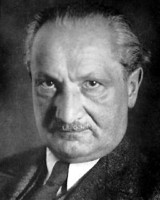
Place of Origin
Meßkirch (Germany).
Life Dates
1889-1976 CE.
Quote
“The question is: Why is there any being at all and not rather Nothing?… How did it come about that with Being it really is nothing and that the Nothing really is not? Is it perhaps from this that the as yet unshaken presumption has entered into all metaphysics that “Being” may simply be taken for granted and that Nothing is therefore made more easily than beings?” [“The Way Back into the Ground of Metaphysics”]
Brief Note
Heidegger was a university professor, teaching at Marburg and then at Freiburg (Germany). He was a student and disciple of the famous phenomenologist Edmund Husserl, from whom he later distanced himself. Heidegger’s best known work is Sein und Zeit [Being and Time], in which he attempted to understand the nature of being, which he considered to be the fundamental problem for philosophy. He was typically considered the leading existentialist philosopher in Germany.
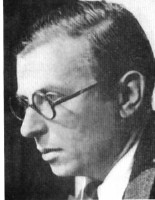
Place of Origin
Paris (France).
Life Dates
1905-1980 CE.
Quote
“L’Enfer, c’est les Autres.” (“Hell is other people.”) [Huis clos (“No Exit”), scene v]
Brief Note
Sartre pursued philosophy in Parisian cafés rather than in the halls of a university. He is as well known for his literary endeavors (novels like Nausea, plays like No Exit and Dirty Hands) as well as for his works in pure philosophy (L’etre et le néant [Being and Nothingness] is his most famous). He is probably the best known of the twentieth-century existentialists (that is, those who claim that “existence precedes essence”). Many of his claims are most convincing while sitting in a café, smoking a pipe, with a cup of coffee before you, and watching the voiceless people passing by on the other side of the window glass.

Place of Origin
Paris (France).
Life Dates
1908-1986 CE.
Quote
“Man is defined as a human being and a woman as a female - whenever she behaves as a human being she is said to imitate the male.”
Brief Note
A gifted and influential French author and existentialist philosopher, her book The Second Sex (1949) became an early classic of feminist theory. She and Jean-Paul Sartre (see above) were near life-long companions, but out of principle refused to marry.
Text prepared by Steve Naragon (Manchester College), 1992.
Last modified: 28 Jul 2007
Please send comments and questions to:
ssnaragon@manchester.edu